The promise is real. Automation can cut repetitive operational work and speed recovery. But autonomy fits some systems and incidents far better than others, and a badly scoped automated fix can turn a small problem into an outage.
This article gives you a practical framework. It covers where self-healing works, where it fails, and what safeguards to put in place before letting automation act in production.
Key Takeaways
- Self-healing is a closed loop of detection, diagnosis, remediation, and validation, not just a restart script.
- It fits frequent, well-understood, reversible problems with strong telemetry and a small blast radius.
- It fails on stateful systems, irreversible actions, missing context, and feedback loops.
- Start low-risk, measure results, and keep humans in the loop for data, security, and compliance actions.
What Is Self-Healing Infrastructure, and How Does It Work?
Definition and boundaries
Self-healing infrastructure detects abnormal conditions and runs a corrective response with minimal human intervention. The key word is loop. IBM's policy-based self-healing model discovers a failure, compares current state to goal state, plans a correction, executes it, and repeats, as described in IBM's documentation.
That excludes some things people often label self-healing:
- A restart script acts but never checks whether the restart worked.
- Autoscaling adjusts capacity against a metric, but doesn't diagnose a fault.
- Kubernetes reconciliation restores declared state, but restarts don't fix underlying application defects.
- AI-assisted remediation adds correlation and root-cause suggestions, but still needs policy and success criteria.
The operating loop
A working loop has seven stages:
- Collect signals
- Detect an anomaly
- Establish context
- Identify a likely cause
- Choose a remediation
- Execute it
- Validate the result
Telemetry feeds the loop. Metrics, logs, and traces cover the basics. Deployment events, health checks, dependency maps, and configuration state supply the context that makes a diagnosis trustworthy.
Controls keep the loop from becoming an uncontrolled change:
- Confidence thresholds and blast-radius limits
- Approval workflows for sensitive steps
- Rollback plans tied to predefined success criteria
- Audit logs recording what ran, when, and why
Argo Rollouts shows the pattern well. Metric analysis returns Successful, Failed, or Inconclusive, and an inconclusive result pauses the rollout for a human rather than pushing ahead.
ML can help correlate signals and adapt to shifting baselines. It still cannot replace explicit policies, reliable data, and a clear definition of "recovered."

Where Self-Healing Infrastructure Works Best
Repeatable and reversible problems
The best candidates have a known trigger, a documented response, and a fix you can reverse or safely retry. Common examples include:
- Restarting a failed stateless service
- Replacing an unhealthy container
- Draining a node
- Correcting known configuration drift
- Retrying a transient operation
These work early because they're frequent, low impact, predictable, and easy to measure.
Kubernetes and cloud-native workloads
Kubernetes ships with reconciliation. Liveness failures restart containers, readiness failures pull a pod from Service traffic, and ReplicaSets keep the desired pod count. Node drains respect PodDisruptionBudgets, so a drain that would breach healthy-replica limits is blocked.
The boundary matters. Kubernetes restores declared resources. It won't spot database exhaustion, a faulty feature flag, or a bad deployment. A Deployment that exceeds its progress deadline does not roll back automatically.
Extending self-healing means adding observability and release controls. Argo Rollouts and Flagger evaluate error rate, latency, and custom metrics, then abort or roll back a degrading release.
Elastic capacity and cloud resource management
Capacity problems suit bounded automation: scale compute, adjust queue workers, or expand a volume before it fills. The catch is cost. An action that fixes performance by quietly multiplying spend isn't a fix, so set limits on how far automation can scale.
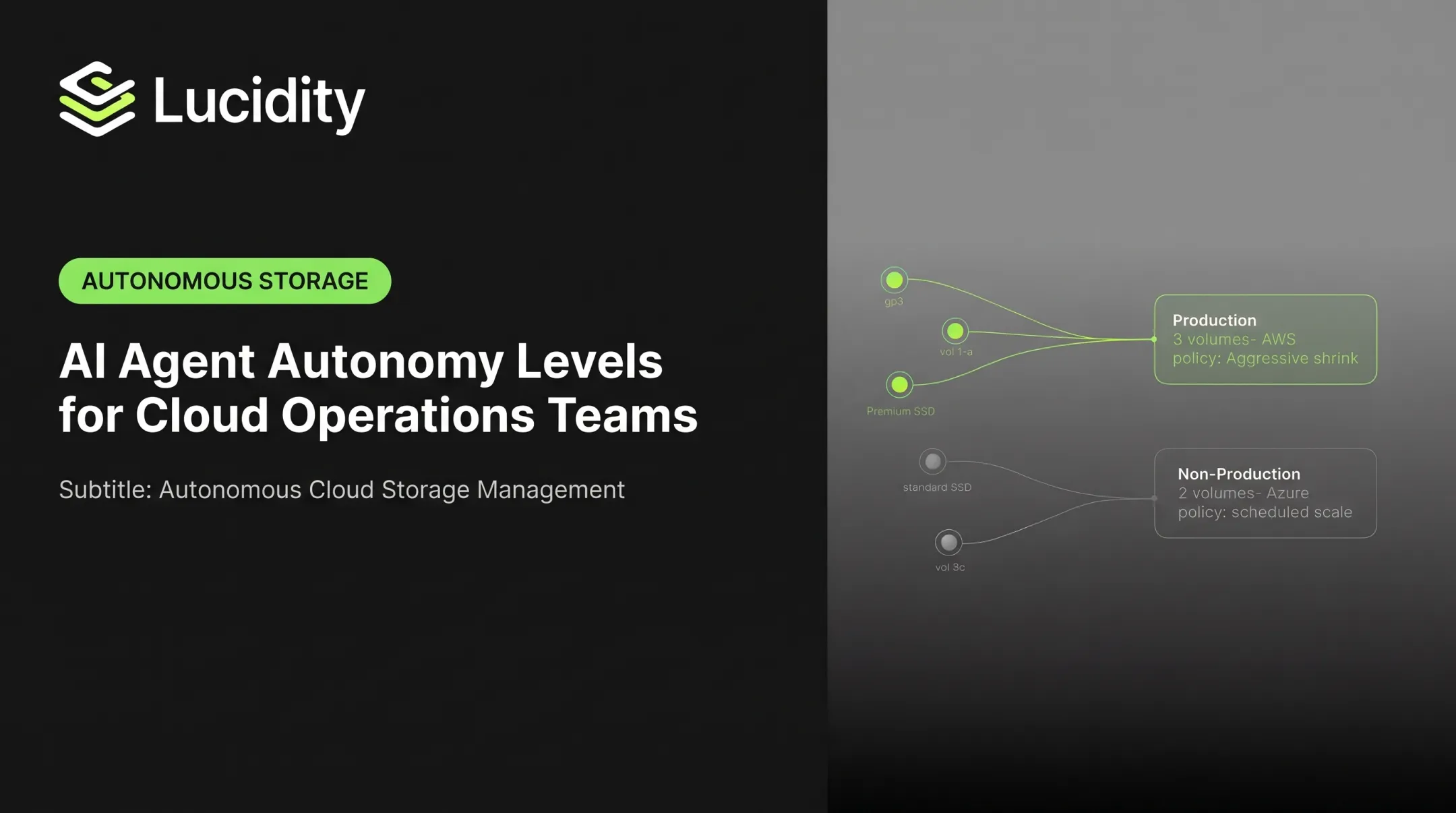
Block storage is a good specialized example, though it is storage autonomy rather than whole-stack healing. Provider rules make manual resizing fiddly:
- AWS EBS allows four modifications per rolling 24 hours, and volumes can't shrink.
- Azure managed disks and Google Persistent Disk also can't shrink.
- Extending a disk often still requires a separate filesystem expansion.
Lucidity's AutoScaler targets this repetitive work. It is an application-agnostic layer that expands, shrinks, and optimizes block storage across AWS, Azure, and Google Cloud without code changes or downtime.
Lucidity reports savings of up to 70%, a vendor figure you should validate against your own estate. Its Lumen product adds tiering recommendations scored on IOPS, throughput, latency, and cost.
Waste is the backdrop. Flexera's 2026 cloud report puts estimated wasted IaaS and PaaS spend at 29%, though that is a respondent estimate, not proven recoverable savings.

Proactive maintenance and known drift
Some fixes can be planned. Examples include patching a known noncompliant configuration, rotating an expiring certificate through a tested workflow, or moving workloads off a degraded node.
Details still bite. cert-manager renews certificates, but applications must reload the new files or restart. AWS Config auto-remediation can act on stale compliance snapshots and touch resources that are already compliant.
Predictive actions need reliable history. Until accuracy is proven, have them recommend or request approval.
A practical decision test
Ask six questions before automating:
- Is the problem common?
- Is the signal trustworthy?
- Is the action reversible?
- Is the scope limited?
- Is the desired outcome measurable?
- Are the dependency impacts understood?
Look for tasks shaped like "Every time X happens, do Y, then verify Z." Skip anything needing business context or heavy human judgment.
Where Self-Healing Infrastructure Fails
Novel, ambiguous, or poorly understood incidents
With no known pattern, contradictory telemetry, or several plausible causes, automation guesses. An AI agent lacking change history and dependency data can pick a plausible but wrong fix.
Benchmarks are sobering. ITBench, presented at ICML 2025, reported 11.4% SRE scenario resolution across four LM-based agents. That's a benchmark, not a production figure, but it argues for caution.
Escalate to a human when:
- Confidence is low
- Signals disagree
- The system can't explain why its action should work
Stateful systems and high-blast-radius actions
Databases, financial transactions, data pipelines, and ordered systems aren't stateless services. Force-deleting a Pod removes it from the API without confirmed termination, so old and replacement processes can overlap and cause split brain or data loss. An RDS Multi-AZ failover typically takes 60 to 120 seconds and requires reconnection.
Treat these as dangerous without a tested rollback:
- Deleting data or changing schemas
- Failing over a primary
- Revoking access
- Editing network controls
Require backups, canary execution, explicit approvals, and service-owner review.
Incomplete observability and hidden dependencies
Gaps that push automation toward the wrong cause include:
- Missing metrics
- Stale topology maps
- Noisy alerts
- Disconnected cloud accounts
A local fix can also hurt a neighbor when shared capacity or traffic flow is misunderstood.
Run a telemetry and dependency-mapping assessment before introducing autonomous remediation.
Runaway automation, oscillation, and cost
Feedback loops are the classic failure. Common patterns include:
- Scaling flaps up and down
- Processes that restart endlessly
- Competing policies that fight each other
- Remediation that hides a recurring defect
Real incidents show the scale. In AWS's US-EAST-1 event, automated capacity scaling triggered unexpected client behavior, and retries amplified the congestion. AWS's own retry example shows multilayer retries producing 243x database load.

Useful defenses include:
- Cooldown periods and maximum retries
- Rate limits and circuit breakers
- Action budgets
- Automatic disablement when recovery isn't confirmed
Security, compliance, and governance
Self-healing doesn't remove least-privilege access, separation of duties, or change records. NIST SP 800-53 covers these under AC-6, AC-5, and CM-3.
These actions generally need approval and detailed audit trails:
- Isolating hosts
- Changing firewall rules
- Rotating credentials
- Editing identity policies
Every automated action still needs an owner, an explanation, an approval policy, and an escalation route.
How to Implement Self-Healing Infrastructure Safely
Start with a narrowly defined use case
Pick a frequent, low-risk, high-confidence problem with a simple fix and a measurable recovery signal. Document the current manual workflow, its time cost, and its failure impact.
Begin in read-only or approval-required mode. Avoid tasks that change often, lack clear ownership, or need multi-step judgment.

Lumen shows this staging in practice: it explains why a tier change is recommended, backs the call with historical IOPS, throughput, latency, and cost trends, and supports rollback.
Build the detect-diagnose-act-verify workflow
Connect observability data to a controlled automation layer. Define each of the following before you automate:
- Trigger
- Permitted action
- Expected result
- Timeout and retry policy
- Escalation condition
Test against:
- Normal behavior and partial failures
- Noisy signals and dependency failures
- Rollbacks and simultaneous incidents
One caution: Azure Automation's test pane runs real resource actions on the Draft runbook, so use non-production resources. It is not a no-change dry run.
Add guardrails and measure outcomes
Use these controls:
- Least-privilege credentials
- Confidence thresholds and rate limits
- Canary execution and rollback
- Change approvals
- Immutable action logs
Track these outcomes and review them regularly:
- Recovery time and repeat incidents
- False remediations and failed actions
- Manual escalations and resource consumption
- Customer-impacting events

Expand or shrink autonomy based on what the metrics show.
Humans stay responsible for policy design, exception handling, post-incident review, and deciding when to disable a workflow.
Frequently Asked Questions
What is meant by self-healing?
It is automated detection, diagnosis, remediation, and validation of infrastructure issues. Monitoring alone or a restart script doesn't qualify without the verification step.
What is self-healing in Kubernetes?
Kubernetes reconciles toward desired state using health probes, replica replacement, and rescheduling. It can't fix an application defect or failing dependency, so restarts may only repeat the problem.
How does self-healing infrastructure work?
It collects telemetry, detects anomalies, analyzes the likely cause, runs a controlled remediation, and verifies recovery. If verification fails, it escalates or rolls back.
Where is self-healing infrastructure most useful?
In repeatable, low-risk, reversible cases: stateless service recovery, known configuration drift, bounded scaling, and capacity management.
What are the limitations of self-healing infrastructure?
Incomplete observability, novel incidents, stateful systems, and high-blast-radius changes cause trouble. So do automation loops and governance requirements.
How can organizations implement self-healing safely?
Roll out in phases, starting with low-risk use cases. Add testing, approvals, least-privilege access, rollback, monitoring, and human escalation.