The pain is measurable. In a CSA survey, 65% of respondents had a business-critical application outage caused by a misconfigured security policy in the past 12 months, and 48% said policy changes are mostly or fully manual.
Agentic remediation pairs AI reasoning with policy-bound automation. It investigates a problem, picks a response, executes approved actions, and verifies the result. This guide covers use cases, the remediation loop, governance, and an adoption path for platform, SRE, ITOps, DevOps, FinOps, and cloud security teams.
Key Takeaways
- Agentic remediation is a governed loop: detect, plan, act, verify, document.
- It weighs dependencies, ownership, and blast radius, unlike single-alert auto-remediation.
- Human approval, least privilege, rollback, and audit logs are non-negotiable.
- Start with narrow, reversible use cases, then expand autonomy as results prove out.
What Is Agentic Remediation?
Agentic remediation uses software agents that observe infrastructure signals, reason about likely causes, act through approved tools, and check whether the environment returned to its intended state.
"Agentic" describes the decision loop, not unrestricted autonomy. The agent works within set objectives, permissions, policies, and escalation boundaries.
Remediation vs. mitigation
NIST defines remediation as "actions taken to correct known deficiencies and weaknesses" once a vulnerability is identified. Mitigation reduces risk or impact.
In practice, mitigation is often the temporary step (isolating a workload) and remediation is the durable fix (correcting the configuration). The official definitions overlap, so treat the split as a working convention.
Beyond security patching
Common targets include:
- Configuration drift and failed deployments
- Capacity constraints and performance degradation
- Unhealthy workloads
- Compliance violations and excessive permissions
- Validated cloud waste
What a credible approach includes
- Context awareness: accounts, workloads, dependencies, owners, SLOs, change windows, business impact
- Goal-oriented planning: weighing options such as patch, reconfigure, scale, isolate, roll back, replace, or escalate
- Controlled execution: APIs, infrastructure-as-code, runbooks, and ticketing, never unrestricted command access
- Verification and evidence: pre-checks, post-checks, approvals, rollback status, and final resource state
How Does Agentic Remediation Work in Cloud Infrastructure?
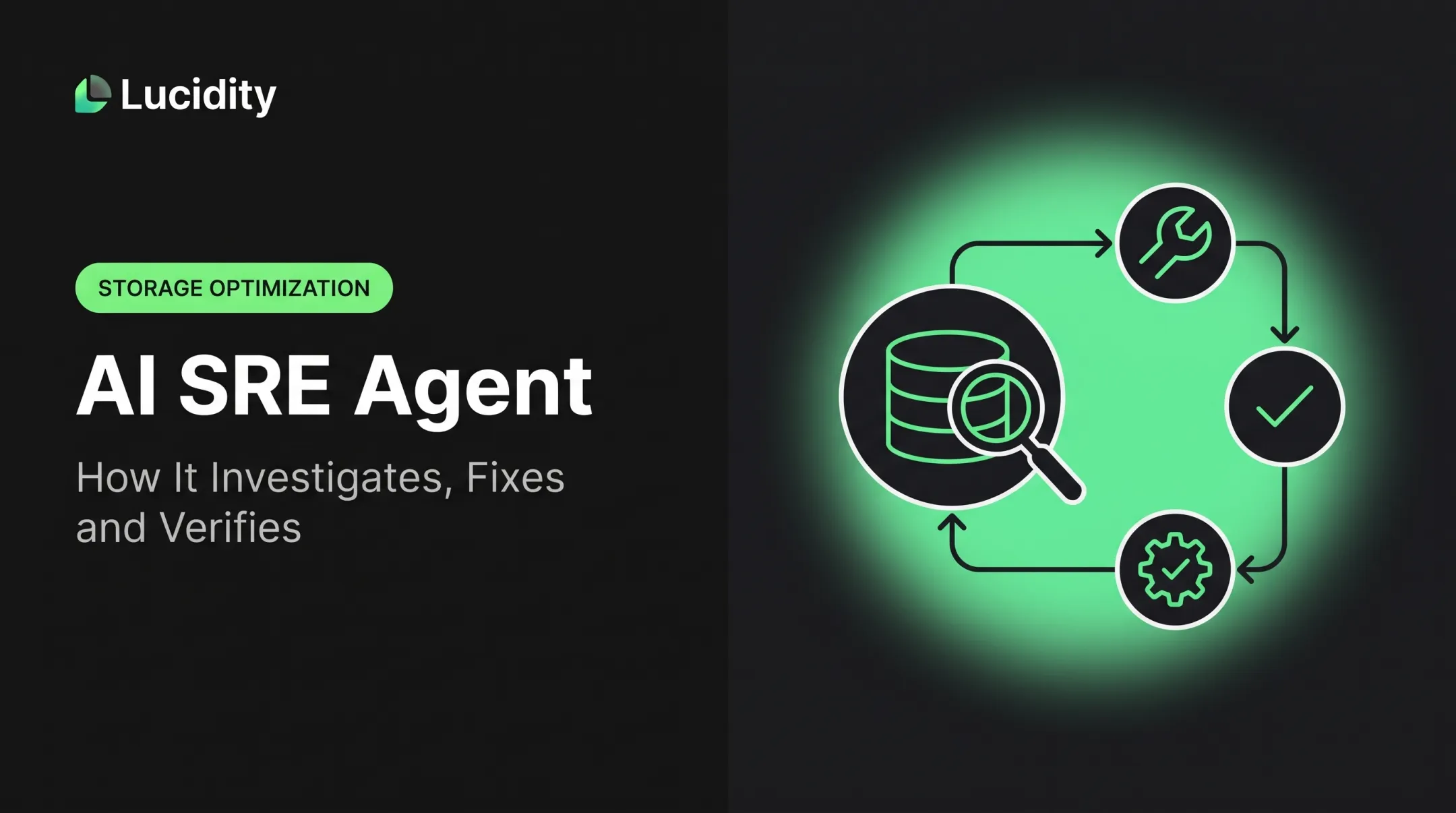
Think of a closed loop: observe, understand, plan, approve, execute, verify, then learn or escalate. Every stage leaves an auditable record.

Microsoft documents this pattern for its Azure SRE Agent: diagnose, identify an action, check permissions, execute or propose, then verify the fix.
Observe and understand
The agent correlates alerts from observability, security, cost, and configuration systems with resource metadata, dependency maps, recent changes, and ownership. Lucidity's platform follows the same principle for block storage, continuously monitoring every volume across AWS, Azure, and Google Cloud.
Before proposing anything, the agent asks:
- Is the issue real?
- Is the resource production-critical?
- Is a maintenance window available?
- Does an existing control already reduce the risk?
Plan, approve, execute
Common plans include:
- Reverting a faulty configuration
- Adding capacity
- Restarting a failed workload
- Applying a secure setting
- Changing a storage tier
- Opening a pull request for an IaC change
Low-risk, reversible actions can qualify for policy-based execution. High-impact actions need human approval, staged rollout, change-management sign-off, or escalation.
Verify the result
A successful API call is not a resolved issue. Verification should:
- Run post-checks on health, configuration state, availability, performance, and connectivity.
- Compare results against the original objective and service-level indicators.
- Roll back, pause, or escalate when validation fails.
- Capture evidence for incident reviews, audits, and FinOps reporting.

Google's SRE guidance on canary releases offers a useful model: expose a small population for a limited time, compare against control, then proceed or roll back.
Where Can Cloud Teams Apply Agentic Remediation?
Three categories suit gradual automation.
Security and configuration
Agents investigate exposed services, excessive permissions, and drift, then propose a change, apply it through an approved workflow, and confirm that exposure dropped without breaking dependencies. The need is real: Orca's 2025 cloud security report found 17% of organizations have an IaC artifact configuring S3 buckets for public GET access. That's an IaC finding, not proof of production exposure.
Reliability and operations
Unhealthy workloads, failed deployments, capacity pressure, and expiring certificates are good candidates. The agent correlates telemetry with recent changes, then selects a runbook, rollback, scale action, or human escalation.
FinOps and resource remediation
Target validated idle, unattached, over-provisioned, or poorly placed resources. Check ownership and business context before rightsizing, scheduling, tiering, or decommissioning. Flexera's 2026 report puts respondent-estimated cloud waste at 29%, though that is an estimate, not metered savings.
An adjacent example: cloud block storage
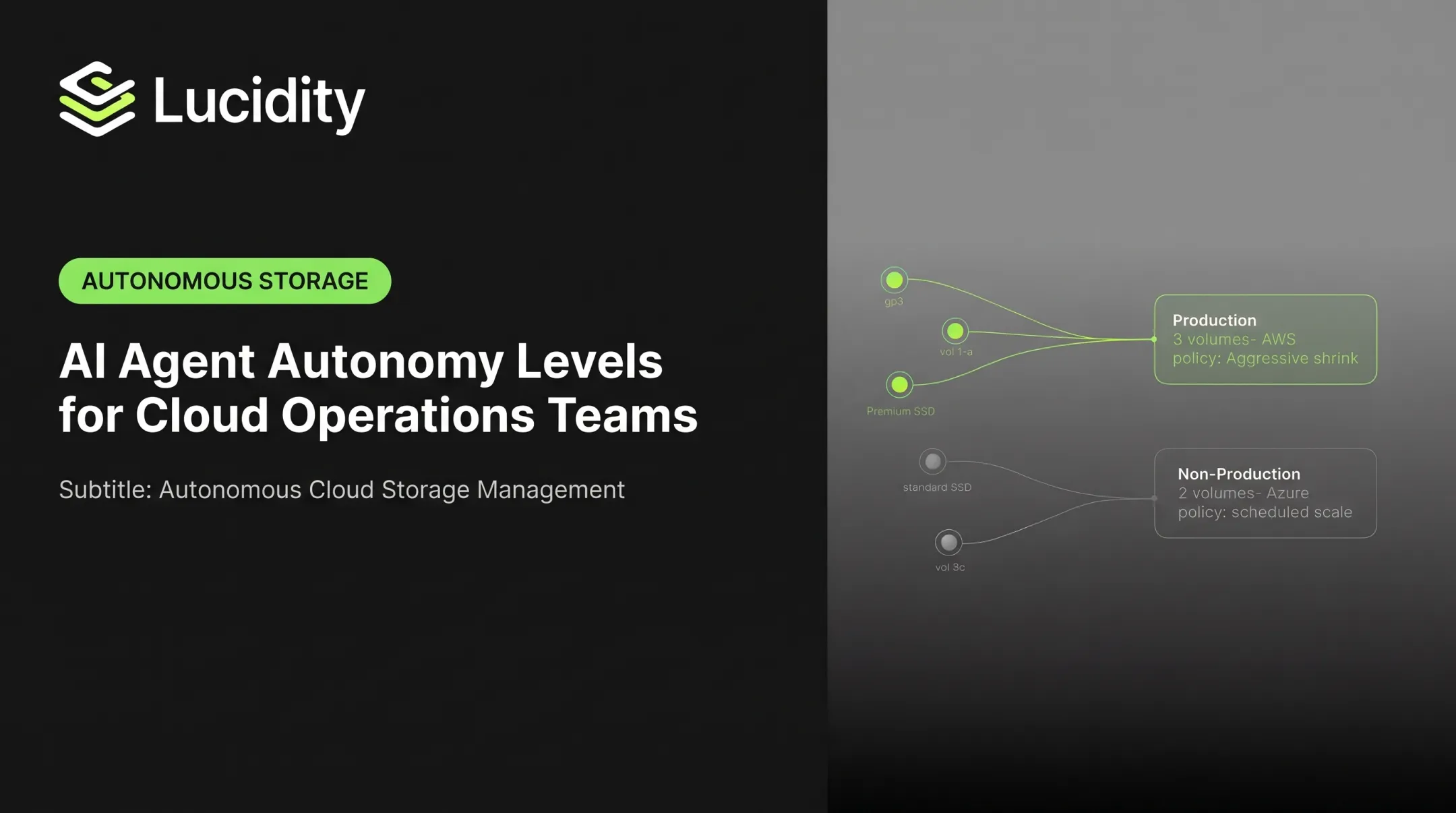
Lucidity illustrates autonomous optimization in one narrow domain. Its platform gives visibility across cloud block storage and automates expansion, shrinking, and optimization without infrastructure changes. Its Lumen product identifies four idle-disk types and runs tier moves with scheduling, one-click execution, or rollback:
- Unattached
- Reserved
- Unmounted
- Zero-I/O
World Market's Sr. Director of Engineering said Lucidity handles disk-space expansion and takes that daily operational load off support.
This is a storage-optimization example. It does not remediate every infrastructure or security issue.
Agentic Remediation vs. Traditional Automation and Manual Remediation
| Dimension | Manual | Rule-based automation | Agentic remediation |
|---|---|---|---|
| Decisions | Human judgment | Predefined conditions | Context-based, within policy |
| Context | Whatever the operator checks | Usually one signal | Dependencies, ownership, changes |
| Execution | Hands-on | Fixed script | Approved tools, staged |
| Validation | Operator-dependent | Often none | Built-in post-checks |
| Escalation | Ad hoc | Rare | Defined triggers |
Basic auto-remediation can be unsafe. AWS itself notes that Config's periodic compliance snapshots can be stale enough to trigger remediation on resources that are already compliant.
Reacting to one alert without considering dependencies, deployments, or blast radius invites exactly that kind of error.
Agentic remediation doesn't replace IaC, change management, runbooks, monitoring, or human expertise. It coordinates them and cuts investigation toil. It also isn't approval-free: Azure supports approval-gated writes, and AWS's Kiro integration uses a human pull-request gate.

Decision guide
- Deterministic automation: repetitive, well-understood, low-risk actions with stable inputs.
- Agentic remediation: issues needing cross-system correlation, a choice among responses, or iterative investigation.
- Human-led: actions that are irreversible, poorly understood, business-critical, or lack reliable validation.
How Should Cloud Teams Adopt Agentic Remediation?
1. Baseline first
Document your current state before introducing agents:
- Alert sources and remediation workflows
- Owners, approval paths, and mean time to remediate
- Change-failure rate, rollback frequency, and engineering hours on repetitive work
DORA metrics (change lead time, deployment frequency, failed deployment recovery time, change fail rate, rework rate) are a solid starting set.
2. Pick a contained pilot
Choose a low-risk, reversible workflow with clear success criteria: a known drift pattern, a non-production recovery runbook, or a validated capacity action. Don't start with broad production access or irreversible deletion.
3. Set autonomy levels
Gartner's autonomy framework maps well here:
- Recommendation-only: investigation, diagnosis, proposed plans.
- Human-approved execution: production, security posture, availability, cost commitments, or dependent resources.
- Policy-based execution: narrow, reversible actions with reliable pre- and post-checks.
- Automatic escalation: incomplete context, low confidence, failed validation, or out-of-scope permissions.

4. Build guardrails before scaling
Put controls in place before you expand scope:
- Least-privilege access and short-lived credentials
- Environment segmentation and approved tools only
- Secrets protection, immutable logs, and rate limits
- Kill switches, approval records, and tested rollback
Treat external data as untrusted and validate agent outputs before execution, as OWASP's agent security guidance advises.
5. Integrate and measure
Connect the systems agents need to act safely: cloud APIs, observability, CMDB, ticketing, incident management, CI/CD, IaC repositories, policy engines, and change calendars. Then track:
- Time from signal to verified resolution
- Share of actions completed without escalation
- Rollback and change-failure rates
- False-positive remediation attempts
- Operator acceptance

Review every failed or unexpected action and feed findings back into policies, runbooks, and approval thresholds. Expand only after the pilot proves consistent, explainable, reversible outcomes. Gartner forecasts over 40% of agentic AI projects will be canceled by the end of 2027, citing cost, value, and control problems—so prove the pilot before you scale.
Frequently Asked Questions
What is the difference between mitigation and remediation in cybersecurity?
Mitigation reduces the likelihood or impact of a risk. Remediation corrects the underlying vulnerability or restores the secure state. In cloud work, isolating a workload mitigates; fixing the misconfiguration remediates.
What are the steps in the vulnerability management process?
Discover assets, identify vulnerabilities, prioritize by risk, remediate or mitigate, validate, document, and monitor continuously. Agentic remediation can assist with investigation and execution, but governance and approvals stay with your team.
What is the average time it takes to remediate vulnerabilities?
It varies with severity, exploitability, asset criticality, and change windows. Edgescan's 2026 report found a 54.81-day mean for high and critical application and API vulnerabilities in 2025. That figure covers apps and APIs, not cloud infrastructure alone.
What does auto remediation mean?
It's an automated response that applies a predefined action when a condition is detected, like AWS Config running a selected remediation action on a noncompliant resource. Agentic remediation adds contextual planning, bounded decisions, and a verification loop.
How does agentic remediation work in cloud infrastructure?
It observes, contextualizes, plans, seeks approval, executes, verifies, and escalates when needed. For a failed deployment, it might correlate errors with a recent change, propose a rollback, and confirm service health afterward.
What safeguards should cloud teams require before enabling agentic remediation?
Require least-privilege access, approval gates for high-impact changes, and reversible actions with tested rollback. Add pre- and post-checks, monitoring, audit logs, environment scoping, and human escalation when the situation is uncertain.