Most teams hit the same three walls. They can't tell how the formula works, so they can't predict what a change will do. They have hundreds of recommendations and no clear order. And they worry that acting on a recommendation, like resizing a VM or deleting a disk, will break something in production.
This guide explains how the score is calculated, what moves it without any fix, and a safe process for raising it.
Key Takeaways
- Advisor Score measures adoption of recommendations across five categories, not completed tasks.
- Cost, security, reliability, performance, and operational excellence each use different scoring methods.
- Dismissing or postponing a recommendation removes it from scoring without fixing anything.
- Validate each change against telemetry and workload owners before you apply it.
- Pair Advisor with Azure Monitor and Cost Management.
What Is Azure Advisor and What Does Advisor Score Measure?
What Azure Advisor does
Azure Advisor analyzes resource configuration and usage telemetry and recommends ways to optimize your deployments. Its five categories map to Azure Well-Architected Framework pillars.
| Category | Example recommendation |
|---|---|
| Cost | Resize or shut down underutilized VMs |
| Security | Require FTPS in a web app |
| Reliability | Enable backup to protect VM data from accidental deletion |
| Operational excellence | Create Azure Service Health alerts |
| Performance | Use managed disks to prevent disk I/O throttling |
Each recommendation lists impacted resources, a low, medium, or high impact rating, and suggested actions. Supported recommendations offer Quick Fix for bulk remediation in the portal.
What the score tells you
You get an overall percentage plus a score per category. A score of 100% means all assessed resources follow recommended practices. 0% means none do. Only assessed resources count.
A high score doesn't guarantee compliance, security, or uptime, and a low score is a prompt to investigate, not an incident. The Well-Architected Framework supplies the design principles. Advisor turns selected ones into resource-level recommendations your teams can act on.
How Is Azure Advisor Score Calculated?
The overall score
Per Microsoft's score documentation, the overall score is the sum of applicable category scores divided by their combined highest potential scores. Normally that is the mean of the five categories. Only applicable categories enter the calculation.
Microsoft's own example gives an overall 83%:
- Cost: 73
- Operational excellence: 77
- Performance: 100
- Reliability: 85
- Security: 80
Category methods
Reliability, Performance, and Operational Excellence use a health ratio:
- Subcategory score = healthy resources ÷ total applicable resources × 100
- Healthy resources meet the assessment criteria and have no recommendations against them
- The category score is a weighted average of subcategory scores
Published subcategory weights (March 2025 model) include:
- Reliability: Zone Resiliency 30, Regional Resiliency 25, Data Protection and Recovery 20
- Performance: Compute, Storage, and Network Optimization at 25 each, Data Performance 20
- Operational Excellence: Efficiency Optimization 30, Failure Mitigation 20

Cost works differently. Subscription scores are weighted by consumption. Resource ratios use retail cost, and recommendation effect and age also matter. Microsoft doesn't publish the full coefficients, so you can't reproduce this score by hand.
Security has its own methodology with no independent Advisor-only equation.
An illustrative example
These numbers are fictional. Say a Reliability category covers 100 applicable resources in one subcategory, and 60 are healthy. That gives a subcategory score of 60.
Fix a high-impact recommendation covering 20 resources and the subcategory reaches 80. If Reliability is the only category that changed, the overall score moves by a fifth of that gain, because the mean spans five categories.
Why the score changes without a fix
- Dismissed or postponed recommendations are excluded at the next refresh
- Manually completed recommendations count as healthy
- New resources change impacted-resource counts
- Selecting different subscriptions changes the scope
- New or changed recommendation models enter scoring after an evaluation period, typically a few weeks

The score refreshes at least daily. Remediation shows up after at least 24 hours, never immediately.
How to Raise Your Azure Advisor Score
Establish a baseline
Before changing anything, record:
- Overall and per-category scores
- Assessed subscriptions and resource groups
- Active recommendations, affected resources, and age
- Potential score increase per recommendation
Check that Advisor covers the right scope. Dismissed or postponed items and missing permissions can make a baseline misleading. Reader access lets you view recommendations. Contributor or Owner is required to manage them.
Prioritize by impact and value
Treat potential score increase as one factor, not the only one. Favor recommendations with a meaningful score gain, high business impact, manageable effort, and a clear owner.
Sort work into quick wins, medium-risk changes, and production-critical changes. Include security and reliability findings even when their score effect is small.
Validate before you apply
Advisor's VM logic has specific thresholds. The default lookback is 7 days, configurable to 14, 21, 30, 60, or 90. A shutdown recommendation looks for P95 CPU below 3%. Resize targets for user-facing workloads require P95 CPU and network at or below 40% on the recommended SKU.
Seven days can miss month-end batch jobs or seasonal peaks. Extend the lookback and check Azure Monitor for peaks, storage I/O, and latency. Then ask the workload owner to confirm:
- Dependencies and business criticality
- Maintenance windows
- Recovery requirements
- Rollback steps
Savings estimates use retail rates and ignore existing reservations, so they can overstate what you'll save.
Remediate across categories
Practical fixes include:
- Removing orphaned storage
- Right-sizing underused compute
- Enabling backup
- Correcting security settings
- Adding Service Health alerts
- Fixing disk throttling
Choose the method by risk:
- Quick Fix for low-risk, supported items
- Azure CLI or PowerShell for repeatable scripted changes
- Infrastructure as code so fixes don't drift back
- Formal change management for production systems

Use storage visibility for overlooked recommendations
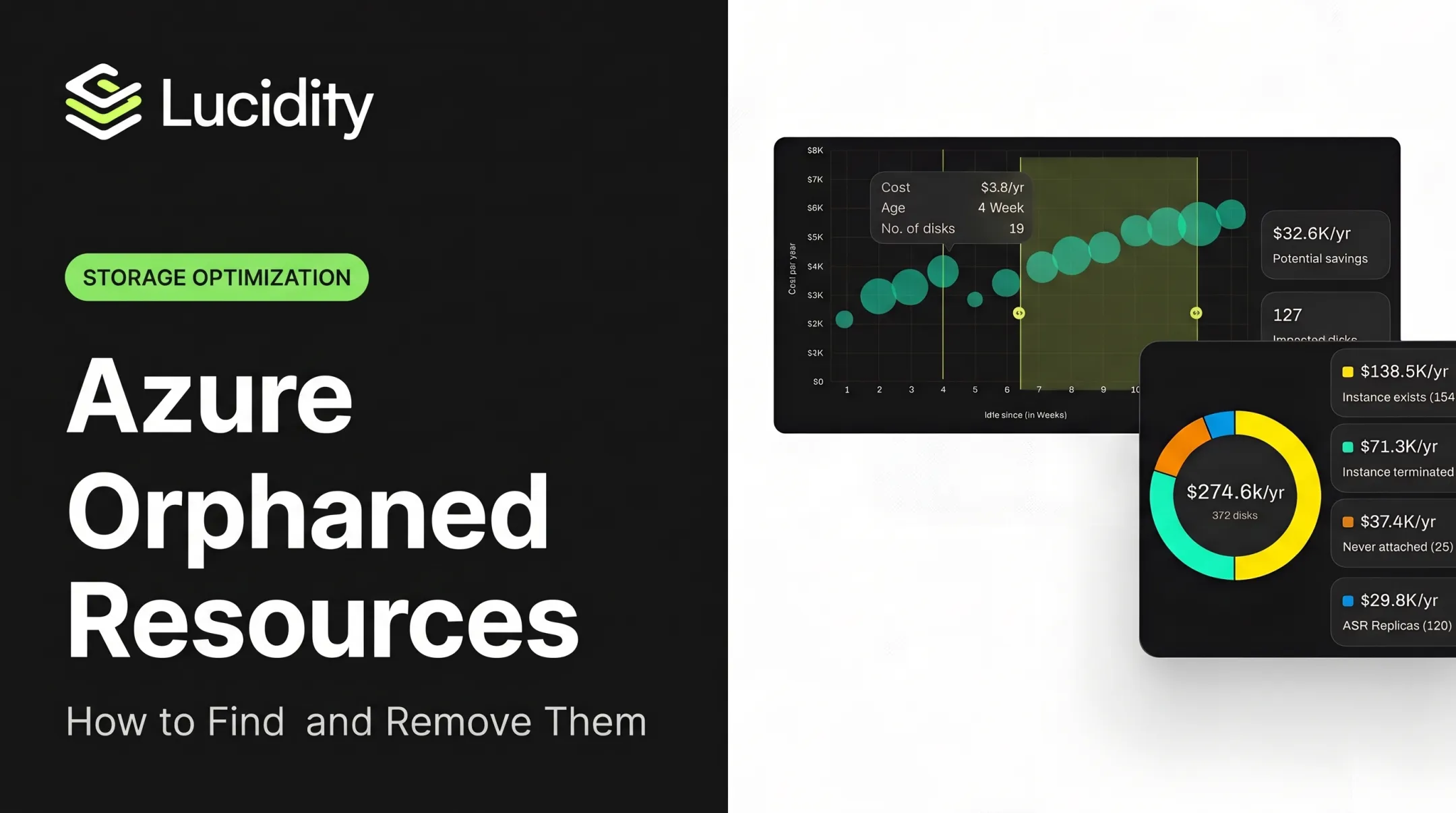
Storage findings are hard to prioritize without a current view of attached, unattached, reserved, unmounted, and zero-I/O disks. Advisor's unattached disk recommendation is a preview and excludes Azure Site Recovery replica disks. Deleting a disk is irreversible, so snapshot it and confirm the data isn't needed.
Lucidity's Lumen addresses this gap. It identifies all four idle disk types, surfaces disks that standard Advisor recommendations miss, and monitors volumes across Azure, AWS, and Google Cloud.
AutoScaler expands and shrinks block storage with zero downtime. Teams should still validate every recommendation. Lucidity doesn't change the Advisor Score directly.
Recheck and measure outcomes
Wait at least 24 hours, then compare scores to your baseline and review history trends. Look beyond the score:
- Verified cost changes in Cost Management
- Utilization, performance, and availability
- Remediation time
- Whether recommendations reappear after the next assessment
Build a Repeatable Azure Advisor Score Improvement Workflow
Assign ownership
FinOps Foundation guidance puts workload optimization with engineering, with FinOps supporting strategy. Map each category to an accountable owner across FinOps, DevOps, ITOps, security, or application teams. Route approved actions into your ticketing or change process.
Combine Advisor with Monitor and Cost Management
Advisor recommends. Azure Monitor supplies telemetry to validate and troubleshoot. Cost Management measures spend and confirms financial impact afterward. Set a review interval that fits your team. A practical cadence covers:

- New high-impact items
- Open work and exceptions
- Recurring findings
- Score trends
Track exceptions
Defer or dismiss only when a recommendation is irrelevant or intentionally postponed. Record the business reason and a review date. A justified exception differs from an unresolved finding. Revisit exceptions periodically, since pricing, requirements, and usage change. Advisor supports dismissal reasons and reactivation.
Conclusion
Advisor Score works best as a prioritization and progress signal. Understand the model, baseline it, fix high-impact findings safely, and verify results.
Sustainable optimization needs coordination across Advisor, monitoring, cost analysis, workload owners, and, for block storage, tools like Lucidity Lumen that show what Advisor can miss.
Frequently Asked Questions
What is Azure Advisor?
It's Microsoft's built-in service that gives personalized recommendations across cost, security, reliability, performance, and operational excellence. See the Advisor overview.
What is the difference between Azure Monitor and Azure Advisor?
Azure Monitor collects, analyzes, and alerts on telemetry. Advisor evaluates configuration and usage to recommend improvements. They work best together.
How often does Azure Advisor Score update?
The score refreshes at least daily. Remediation takes at least 24 hours to appear. Recommendations for new resources can take up to 24 hours.
Does dismissing or deferring a recommendation increase the score?
Yes, because those resources are excluded at the next refresh. Use it only for genuinely irrelevant or intentionally postponed items.
Why did my score change when I fixed nothing?
New resources, scope changes, usage changes, new recommendation models, or new recommendations can all shift it.
Can an Azure Advisor Score reach 100%?
Possibly, for a given scope, if all assessed resources follow recommended practices. It isn't permanent, since workloads and Microsoft's methodology change.