
Cloud teams blur this line constantly. Flexera's 2026 State of the Cloud report puts estimated wasted IaaS/PaaS spend at 29%, reversing a five-year decline. That is a survey estimate of cloud-wide waste, not a block-storage benchmark, but it shows why every "win" gets scrutinized.
This guide defines both terms, compares them, and shows how to measure each in cloud block storage.
Key Takeaways
- Cost savings reduce an existing expense; cost avoidance prevents a projected one.
- Savings trace to invoices; avoidance needs a documented counterfactual.
- Rightsizing and autonomous capacity management can produce both outcomes.
- Report the two separately to protect finance credibility and avoid double-counting.
Cost Avoidance vs Cost Savings: Quick Comparison
| Dimension | Cost savings | Cost avoidance |
|---|---|---|
| Timing | Current or historical cost falls after an intervention | A projected future increase, incident, or purchase is prevented |
| Visibility | Traceable to invoices, billing exports, or budget lines | Often absent from the P&L; tracked in a separate register |
| Baseline | Prior usage or current billing for the same need | Documented counterfactual with consistent demand assumptions and a defined horizon |
| Cloud examples | Deleting idle volumes, shrinking oversized capacity, moving to a cheaper tier | Preventing overprovisioning, avoiding emergency expansion, cutting downtime risk |
| Evidence | Completed-action impact versus the initial estimate | Baseline, intervention evidence, and post-action validation |
FinOps frames the split this way: savings are a reduction from the existing run rate, while avoidance is future expenditure prevented. Even when one project delivers both, report realized savings, avoided spend, utilization gains, and risk reduction as separate lines.

What Are Cost Avoidance and Cost Savings?
What Does Cost Avoidance Mean?
Cost avoidance is a proactive action that prevents a projected future expense. A cloud example: matching block storage capacity to expected demand so you never buy the extra volumes a growth forecast would have required.
The calculation, based on the FinOps Foundation's anomaly playbook:
Projected cost without intervention − actual or projected cost after intervention
Document the forecast, assumptions, time period, and evidence behind the counterfactual. That playbook is anomaly-specific, so treat it as a model rather than a universal storage formula. Assumed duration drives the result, so a weak assumption weakens the claim.
Use Cases of Cost Avoidance
- Preventing capacity overprovisioning before workloads scale
- Avoiding emergency storage expansion after a volume nears full
- Reducing the likelihood of storage-related downtime
- Preventing manual engineering work as environments grow
On the downtime side, ITIC's 2024 report found one hour of downtime exceeds $300,000 for over 90% of mid-size and large enterprises. That is a general enterprise figure, not a disk-full-incident benchmark, so don't book it as an avoided loss without your own incident history.
What Are Cost Savings?
Cost savings are a measurable reduction in current or previously expected cloud spending. They differ from avoidance because the money was already being spent. They also differ from broader efficiency gains, such as higher utilization, which may not change the bill.
The calculation is simple: original baseline cost − new cost. Validate it against provider billing records, invoices, resource inventories, or committed-spend reports.

Use Cases of Cost Savings
- Deleting unattached or unused volumes
- Rightsizing overprovisioned block storage
- Moving workloads to an appropriate storage tier, such as Azure Premium SSD to Standard SSD
- Reducing an existing recurring charge
Provider rules matter here. Orphaned Azure managed disks keep incurring charges, AWS flags unattached volumes as potentially underutilized, and Google bills provisioned space until you delete the disk.
Cost Avoidance vs Cost Savings: Which Is Better for Cloud Costs?
Neither approach wins in every case. Savings deliver immediate impact on the current bill, while avoidance protects future budgets and reduces operational risk. FinOps teams weigh savings, avoidance, and efficiency against implementation effort, risk, and disruption.
Prioritize savings when you can see current waste: idle resources, duplicate volumes, or oversized storage that can shrink without hurting performance.
Prioritize avoidance when the main risk is ahead: demand growth, provider price changes, emergency capacity needs, downtime, or added headcount.
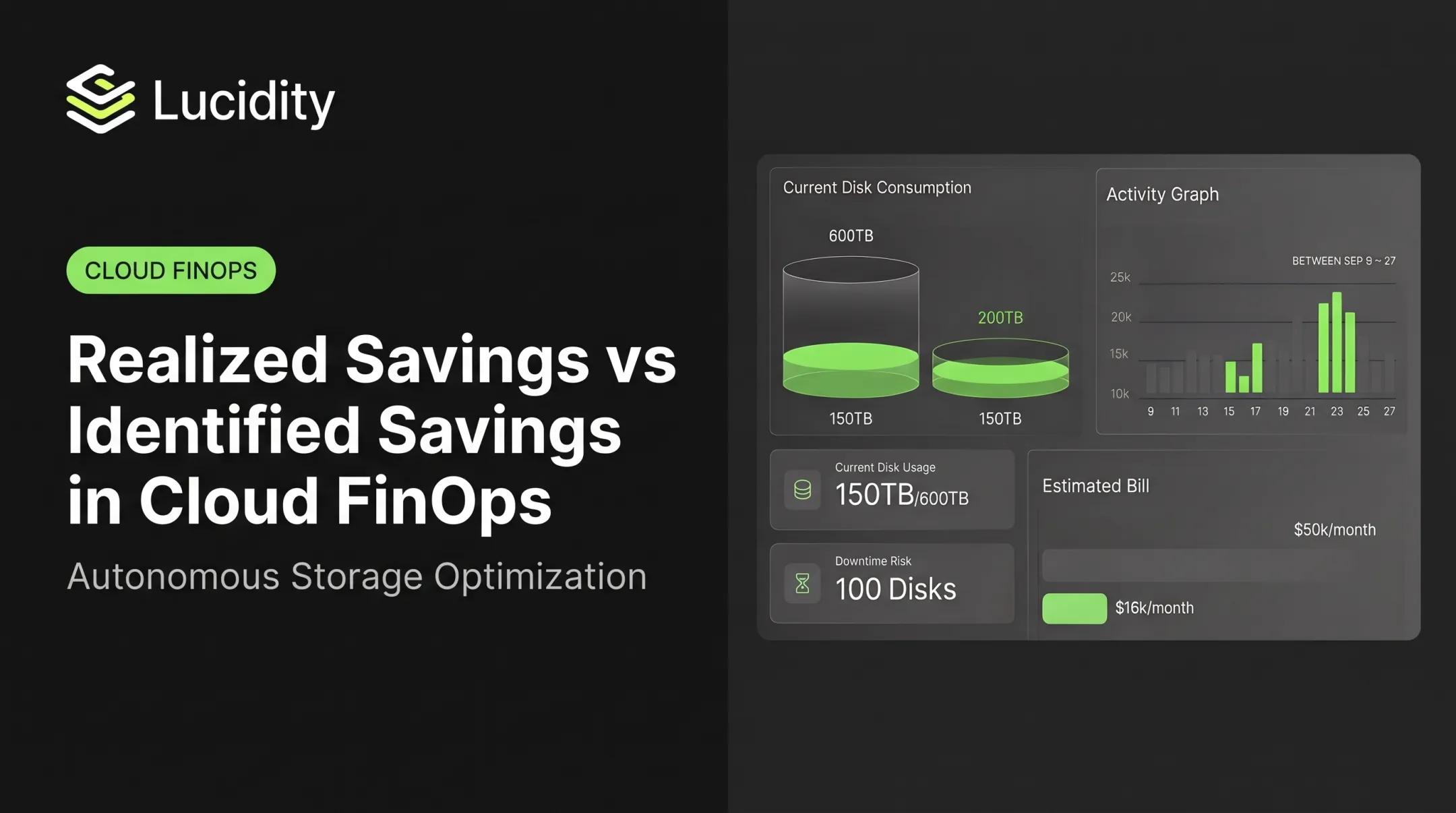
One project can deliver both. Deleting idle volumes lowers today's bill, and automated capacity management then prevents the overprovisioning that would recreate that waste. Calculate each benefit separately so finance can validate both.
A Practical Decision Checklist
- Baseline quality: Do you have billing data or a defensible forecast?
- Workload growth: Will demand rise enough to make avoidance material?
- Performance and availability needs: Can capacity shrink safely?
- Implementation risk: What labor and disruption does the change carry?
- Time to impact: Will the benefit appear this quarter or next year?
- Finance validation: Can finance verify the result?
Governance Comes First
Agree in advance on definitions, owners, approval thresholds, reporting periods, and evidence requirements. Watch for overlap too: AWS adjusts aggregated savings estimates when recommendations interact, so opportunities are not simply additive.
Real-World Cloud Examples and How to Measure Results
Lucidity Customer Results, Classified
Lucidity's case studies show why classification matters. One reported outcome often mixes several benefit types.
| Customer | Reported outcome | How to classify it |
|---|---|---|
| Unnamed life-sciences company | Utilization 30% to 75%; 50% lower monthly storage bill; $1.1M/year block-storage savings | Direct savings plus a utilization gain |
| ESO | Utilization 30% to 70%; 416 engineering hours saved over five months; 50% ROI | Utilization and engineering time; ROI is not a bill reduction |
| Dometic | 52% reduction in cloud storage spend; eliminated risk of possible downtime | Savings for the spend; avoidance for downtime risk |

Treat these as vendor-published results. The ESO case also describes a development disk nearing capacity that was addressed before it filled, but supplies no monetized avoided-outage figure. Report it as risk reduction, not dollars.
How to Measure Before and After
- Billing spend: usage reports show EBS storage in GB-Month, with IOPS and throughput billed separately
- Provisioned versus used capacity: compare daily GB consumed against provisioned
- Utilization: CloudWatch's
disk_used_percentor Google's Ops Agentpercent_used - Idle volumes: count unattached disks before and after cleanup
- Availability: incident records tied to capacity
- Engineering hours: time spent on resizing and ticket triage
Pull every number from billing data or a published case study. Don't invent metrics.
Where Lucidity Fits
Native tools make this hard. AWS EBS allows no in-place size decrease, Azure managed disks don't support native shrinking, and Google Persistent Disk can only grow.
Lucidity's autonomous multi-cloud platform provides real-time visibility and optimizes block storage across AWS, Azure, and Google Cloud without infrastructure or application code changes. Its AutoScaler expands and shrinks disks, while Lumen identifies idle disks and recommends tier moves.

Bank the immediate savings, then document the future costs avoided as separate items. Ready to see where your environment stands? Run Lucidity's free Assessment on your cloud block storage or request a consultation.
Conclusion
Cost savings is the right label for a verified reduction in current cloud spend. Cost avoidance describes a documented future expense your organization prevented.
Mature cloud cost management uses both, reports them separately, and ties financial results to utilization, resilience, performance, and engineering capacity.
Frequently Asked Questions
What does "cost avoidance" mean?
Cost avoidance means preventing a projected future expense. It may not appear as a budget reduction because the money was never going to be spent in the current run rate.
What are examples of cost avoidance?
Preventing future overprovisioning, avoiding emergency capacity purchases, reducing downtime risk, and avoiding extra engineering effort as workloads grow.
How do I calculate cost avoidance?
Subtract the actual or projected cost after intervention from the projected cost without it. Document the forecast, assumptions, time period, and evidence.
What is an example of cost savings?
Deleting idle storage or shrinking oversized capacity so an existing recurring cloud bill decreases.
How are cost savings and cost avoidance different in cloud computing?
Savings are a current billing reduction. Avoidance is a prevented future cloud expense. Track them separately.
Can cloud storage optimization deliver both cost savings and cost avoidance?
Yes. Rightsizing or idle-volume removal creates savings, while autonomous capacity management can prevent future overprovisioning, emergency expansion, and manual effort.