This guide is for teams running US-based Azure environments. It covers deployment-model fit, workload-based VM sizing, managed-disk selection, SQL file placement, cost planning, security, and post-deployment validation.
The governing rule: start from measured CPU, memory, I/O, concurrency, growth, availability, and recovery needs. Database size alone tells you very little.
Key Takeaways
- Size compute from observed peak workload, not database size or a familiar VM name.
- Treat the VM and its disks as one system with combined IOPS and throughput ceilings.
- Plan separate storage for OS, data, log, tempdb, and backups.
- Revisit sizing regularly with Azure Monitor, Query Store, and cost data.
Confirm SQL Server on an Azure VM Is the Right Fit
SQL Server on an Azure VM is IaaS. You control the OS and the SQL Server instance. You also own patching, database backups, monitoring, security configuration, and most high-availability design. Optional automation helps, but it does not turn the deployment into PaaS.
Choose Between Azure SQL Database, Managed Instance, and a VM
| Area | SQL Database | Managed Instance | SQL Server on Azure VM |
|---|---|---|---|
| Feature scope | Most database-level features | Almost all instance features | Full parity with your SQL Server version |
| SQL Agent | No (elastic jobs instead) | Yes, with differences | Yes |
| Linked servers | No (elastic query instead) | Supported, with limitations | Yes |
| OS access | None | None | Full |
| Migration effort | Database-level changes may be needed | High compatibility | Lift-and-shift, minimal changes |
The VM option fits lift-and-shift migrations, legacy applications, configuration-sensitive integrations, and teams that need administrative control. Microsoft's Azure SQL overview covers the IaaS versus PaaS split in more detail.
Clarify Licensing Before Sizing
Licensing shapes the VM design, so settle it first:
- Pay-as-you-go: SQL licensing is included in the per-second VM charge.
- Azure Hybrid Benefit (BYOL): requires eligible core-based licenses with active Software Assurance or subscription entitlement. Infrastructure charges remain.
- Switching models: supported for Standard and Enterprise editions, not Express, Web, Developer, or Evaluation.
Confirm current Microsoft licensing terms before committing.
Size the Azure VM for the SQL Server Workload
Start with a workload inventory:
- SQL Server version and edition
- Database count, size, and expected growth
- Workload type (OLTP or analytics) and concurrent users
- Batch windows and integrations
- Uptime and recovery objectives
- Regulatory requirements
Establish a Performance Baseline
Collect measurements during real peaks, such as month-end processing and ETL, not an idle afternoon. A generic on-premises spec is a poor substitute.
Key signals to capture:
- Total and
sqlservrCPU, Available MBytes, Target versus Total Server Memory - Page life expectancy and lazy writes per second
- Disk reads and writes per second, bytes per second, and latency
- Wait statistics from
sys.dm_os_wait_stats - File-level stalls from
sys.dm_io_virtual_file_stats - Query Store data on duration, CPU, I/O, and plan history
Both DMVs are cumulative since the SQL service started, so sample deltas. Azure Migrate can assess SQL-on-VM readiness, right-size VMs, and estimate cost. Microsoft retired the Data Migration Assistant in July 2025, so use Azure Migrate for those assessments instead.

Match Compute to the Workload
Microsoft's VM size guidance sets the starting points:
- Use at least 4 vCores. Production workloads start at an 8:1 memory-to-vCore ratio.
- D-series offers 4:1, which suits smaller environments.
- Ebdsv5 is Microsoft's best price-performance pick for most production SQL workloads.
- Mbdsv3 targets mission-critical OLTP and data warehouses.
- L-series local NVMe suits transient, high-I/O data, not unprotected durable files.
- Constrained-core variants cut SQL licensing while keeping parent memory and storage bandwidth. Parent compute charges don't drop.
Always verify family availability and regional support in current documentation.
Check the VM Ceiling Against SQL Requirements
A fast disk cannot beat a VM that caps aggregate IOPS, throughput, or disk attachments. Compare these published examples:
| VM size | Max data disks | Uncached Premium SSD IOPS / MB/s | Local temp storage |
|---|---|---|---|
| Standard_E32bds_v5 | 32 | 130,000 / 3,700 | 1,200 GiB SSD |
| Standard_M32bds_v3 | 64 | 88,000 / 2,000 | One 400-GiB disk |
| Standard_L32s_v4 | 64 | 51,200 / 1,696 | Eight NVMe disks |
These are ceilings, not SQL benchmarks. Cached and uncached limits are separate, so don't mix them.
Disk ceilings alone don't finish the sizing picture. Set max server memory to leave headroom for the OS. SQL Server's general starting point is 75% of memory not used by other processes. It isn't a fixed number of gigabytes. Watch concurrency, parallelism, and tempdb activity too.

Plan for Peaks and Growth
Account for seasonal demand, ETL windows, index maintenance, failover capacity, and growth. Buying the largest VM is not a plan. Pick a size with headroom, and make sure you know how to resize.
Validate with Testing
Benchmark one or more candidates with a representative workload. Measure:
- Transaction latency and batch completion time
- CPU and memory pressure
- Storage latency, IOPS, throughput, and queue depth
Document acceptance criteria, test conditions, bottlenecks found, and a rollback or scale-up plan before production.
Design the Storage Architecture
Plan the OS disk, data files, log files, tempdb, and backup or staging space as separate requirements. Each has a different performance and durability profile.
Place SQL Files by Workload Behavior
Data files take concurrent random reads, logs need sequential writes, and tempdb handles bursty temporary work. Sharing one volume forces them to compete for the same IOPS and throughput.
Microsoft's storage best practices recommend separate data, log, and tempdb drives. Consider separate backup storage as well. Restore staging, exports, and maintenance can eat capacity quickly.

Select the Managed-Disk Tier
| Disk type | Max IOPS | Max MB/s | Notes |
|---|---|---|---|
| Standard HDD | 2,000 | 500 | Not for production SQL |
| Standard SSD | 6,000 | 750 | Dev/test |
| Premium SSD | 20,000 | 900 | Production; host caching supported |
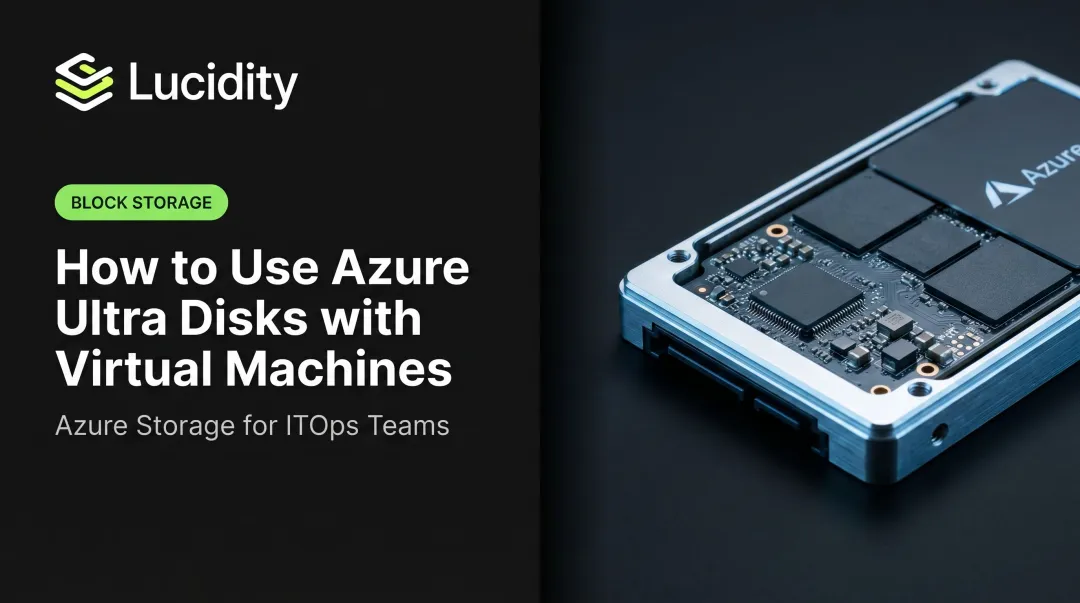
| Premium SSD v2 | 80,000 | 2,000 | No host caching; not an OS disk |
| Ultra Disk | 400,000 | 10,000 | No host caching; not an OS disk |
Maximums are per disk and depend on provisioned settings. Ultra support varies by region and VM size and excludes availability sets. Premium SSD v2 generally needs zonal VMs. The label alone doesn't set performance, so weigh latency, IOPS, throughput, durability, capacity, and cost together.
Calculate Capacity for Growth and Recovery
Size for these factors together:
- Allocated size and free-space policy
- Expected growth and autogrowth behavior
- Index maintenance and log expansion
- Backup retention, snapshots, and restore needs
You can expand a managed disk, then expand the guest volume. Azure doesn't support shrinking an existing managed disk. Shrinking SQL files is a different matter: it can fragment indexes and trigger regrowth. Treat capacity growth as effectively one-way.
Configure Caching, Striping, and Attachment
- Use ReadOnly host caching on eligible data disks and None on logs.
- Skip caching on disks of 4 TiB (P50) and larger.
- Skip host caching on Premium SSD v2 and Ultra Disk; neither supports it.
- Format data volumes with 64-KB allocation units.
- Stripe multiple disks with Storage Spaces (64-KB interleave) when you need more bandwidth, within the VM ceiling.
Striping adds operational overhead. Plan for resiliency, expansion, monitoring, and recovery before you rely on it.
Handle Tempdb and Temporary Storage
Local SSD can hold tempdb, since SQL Server recreates it at restart. The SQL IaaS extension handles folder and startup configuration on Marketplace images. Local contents can vanish on deallocation, host movement, maintenance, or resize. Never keep user databases there.
Size tempdb files for your contention pattern, and test startup behavior after a stop or resize.
Validate Under Realistic Load
Microsoft's disk benchmarking guide documents DISKSPD and cache warm-up before read-cache tests. Pair synthetic tests with representative SQL workloads and measure:
- Read and write latency, IOPS, throughput, and queue depth
- Log-flush performance and tempdb pressure
- Application response time
Compare results to both disk limits and the VM's aggregate limits. Then set alerts for latency, capacity, throughput, and queue growth.
Estimate Cost and Plan Ongoing Optimisation
Estimate Cost and Plan Ongoing Optimization
Break total cost into these categories:
- VM compute and SQL licensing
- Managed-disk capacity and performance
- Snapshots and backup storage
- Monitoring and networking
- HA and DR replicas
- Third-party tooling
Build a Current Azure Pricing Scenario
Use the Azure pricing calculator with a US region. Model uptime, VM size, SQL edition and license option, disk type and capacity, backup retention, monitoring, and HA/DR topology. Premium SSD v2 bills capacity, IOPS, and throughput separately.

Check prices, reservation eligibility, and Hybrid Benefit terms against current Microsoft sources. SQL VM pricing offers one- and three-year reservations. Compute savings plans cover infrastructure only, not software licensing.
Compare Headroom with Under-Sizing
A cheap VM gets expensive when it causes slow queries, missed batch windows, downtime, emergency resizing, or duplicated HA capacity. Model baseline, peak, growth, and failover scenarios, not just one primary VM's monthly bill.
Create a Right-Sizing Loop
Review Azure Monitor, SQL metrics, Query Store, disk utilization, latency, and monthly cost allocation after deployment. Revisit compute and storage separately. A VM may be oversized while disks are constrained, or the reverse.
Reduce Storage Waste Without Risking Recovery
Azure Advisor's cost workbook flags unattached managed disks, which keep billing. Separate real waste from capacity reserved for growth, backups, replication, or DR. Then add governance:
- Tags for owner, cost center, and workload
- Cost Management budgets with actual and forecast alerts
- Retention policies and change control
- Approval workflows for resizing or deleting storage
Where Lucidity Fits
Manual reviews work at small scale. In larger Azure or multi-cloud estates, continuous optimization takes effort. Lucidity is an optional layer for that case.
Its Lumen product shows every disk and recommends tier changes (such as Premium SSD to Standard SSD) based on IOPS, throughput, latency, and cost. AutoScaler expands and shrinks block storage with zero downtime.
It complements SQL Server sizing, monitoring, and governance. It doesn't replace workload testing, SQL administration, backup design, or licensing decisions.
Deployment and Validation Checklist
Deployment Sequence
- Select a supported SQL Server image, or register an existing installation.
- Place the VM in the right virtual network and region.
- Configure the license model.
- Attach and format the planned disks.
- Set SQL Server storage and memory settings.
- Document the final architecture.

Registration and patching defaults to confirm:
- Portal-deployed Marketplace images register with the free SQL IaaS Agent extension automatically
- Self-installed SQL needs manual registration
- Automated patching and backup are off by default in the portal
- Legacy Automated Patching retires September 17, 2027; Azure Update Manager is the replacement
Secure Connectivity
- Use private connectivity restricted to the VNet where possible.
- Scope NSG rules to specific source IPs and ports, including 1433.
- Avoid unrestricted public SQL endpoints.
- Use least-privilege administration
- Prefer Microsoft Entra authentication (SQL Server 2022 or later)
- Enable encryption (TDE, column, backup) and store keys in Key Vault.
Post-Deployment Validation
Confirm each of these before go-live:
- SQL VM registration and patching
- Backups and tested restores
- Monitoring, alerting, and maintenance jobs
- HA/DR behavior and VM resize procedures
- Application connection performance
VM availability SLAs (99.95% for an availability set, 99.99% across zones) are not SQL database RPO/RTO guarantees.
Frequently Asked Questions
How much does it cost to run SQL Server on an Azure VM?
Cost depends on VM compute, SQL licensing, managed disks, backup, monitoring, networking, uptime, region, and HA/DR design. Use the Azure pricing calculator for current figures.
Does Azure offer free VMs or a free tier for SQL Server?
The Azure free account offers limited credit and eligible VM hours, and terms change. SQL Developer and Express carry no license charge, but VM and storage charges still apply.
How do I connect to SQL Server on an Azure VM?
Choose a public, private (VNet-only), or local connectivity path. Configure SQL and firewall settings, scope NSG rules, and choose authentication. Prefer private networking or VPN over exposing port 1433 to the internet.
What are the differences between Azure SQL and SQL Server on an Azure VM?
Azure SQL is managed PaaS with less OS and instance control. A VM gives full control and compatibility, but you handle patching, backups, scaling, and licensing.
Which Azure VM is best for SQL Server?
No single VM wins. The answer depends on measured CPU, memory, I/O, concurrency, growth, edition, storage limits, availability needs, and benchmark results.
Can I run Microsoft SQL Server on an Azure VM?
Yes, using a supported Marketplace image or your own installation. Pick a supported OS and SQL version, then address licensing, storage, security, patching, backup, and monitoring.