Azure storage cost is rarely one line. A single workload can pay for capacity, operations, retrieval, redundancy and egress, each on its own meter, and the meter that hurts is often not the one you budgeted for.
Key Takeaways
- Blob storage ranges from $0.0208 per GB-month (Hot LRS) to $0.00099 (Archive LRS) in East US, a 21x spread for the same data.
- Egress is often the second-biggest line: sending 5,000 GB a month to the internet costs $426.30 at the default $0.087 per GB, 29 percent of the total bill in the 50 TB example worked through below.
- Geo-redundancy more than doubles Blob capacity cost: Hot GRS is $0.0458 per GB-month vs $0.0208 for LRS.
- Managed disks bill by provisioned size, not data stored. An idle 1 TiB Premium SSD costs $1,622 a year with nothing reading it.
What Makes Up Azure storage Cost?
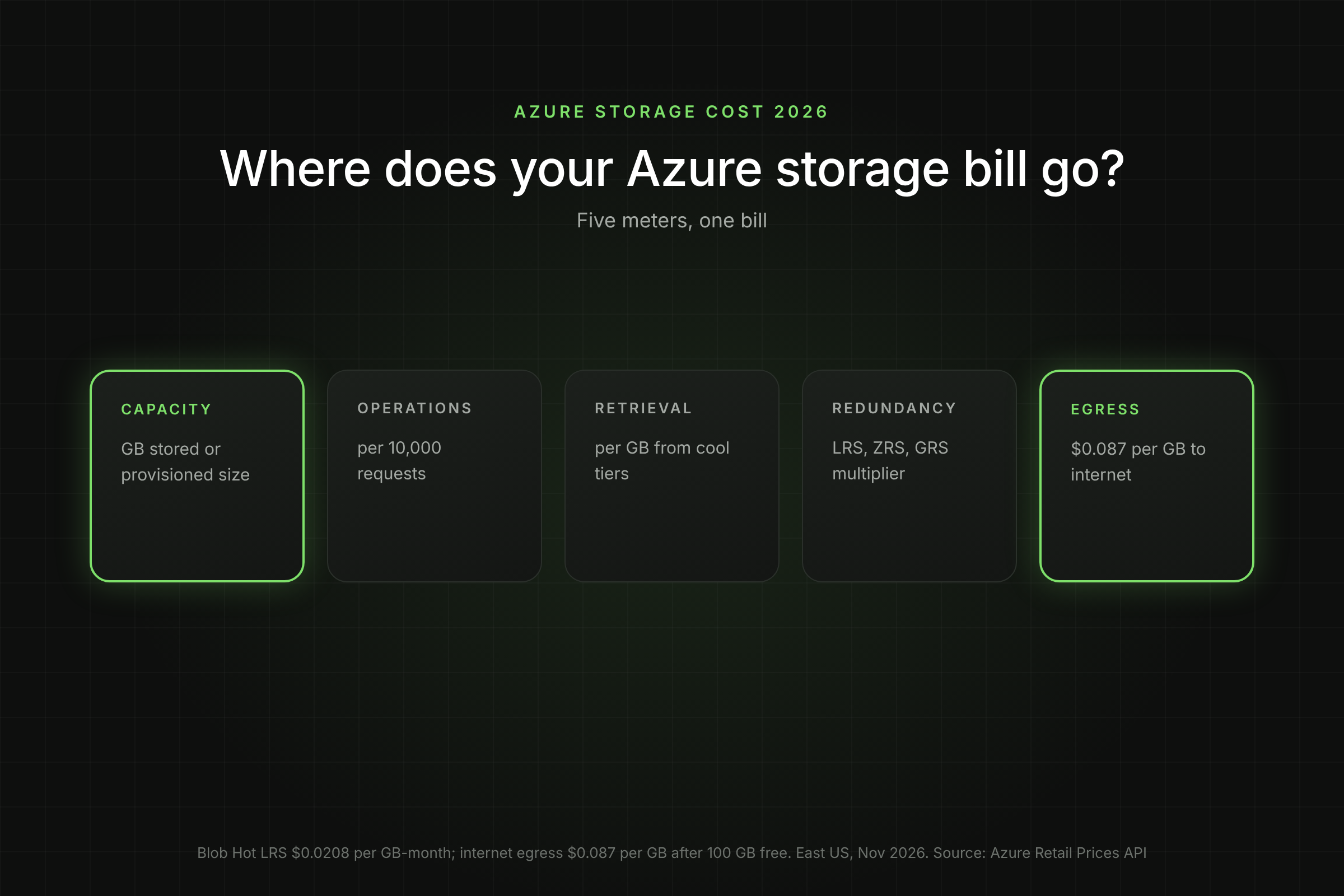
Azure storage cost is the sum of five meters: data stored, operations (reads, writes, lists), data retrieval from cool tiers, the redundancy you choose, and data transferred out. Every storage service uses some mix of them.
The common budgeting mistake is to price capacity only. Capacity is the easiest meter to forecast and usually the largest, but operations and egress scale with traffic, not size, so they grow when the application succeeds. Retrieval fees punish a tiering decision made on the wrong access pattern.
The examples below use East US pay-as-you-go list prices from the Azure Retail Prices API, pulled in Nov 2026. Other regions differ, so re-run the numbers for yours.
How Much does Azure Blob Storage Cost?
Azure Blob storage cost depends mostly on the access tier. Hotter tiers cost more to store and less to read; colder tiers flip that, and add a minimum retention period and a retrieval fee.
Hot LRS gets volume discounts: $0.019968 per GB-month above 50 TB and $0.019136 above 500 TB. Minimum retention periods come from Microsoft Learn, access tiers; deleting or moving a blob early bills the remaining days.
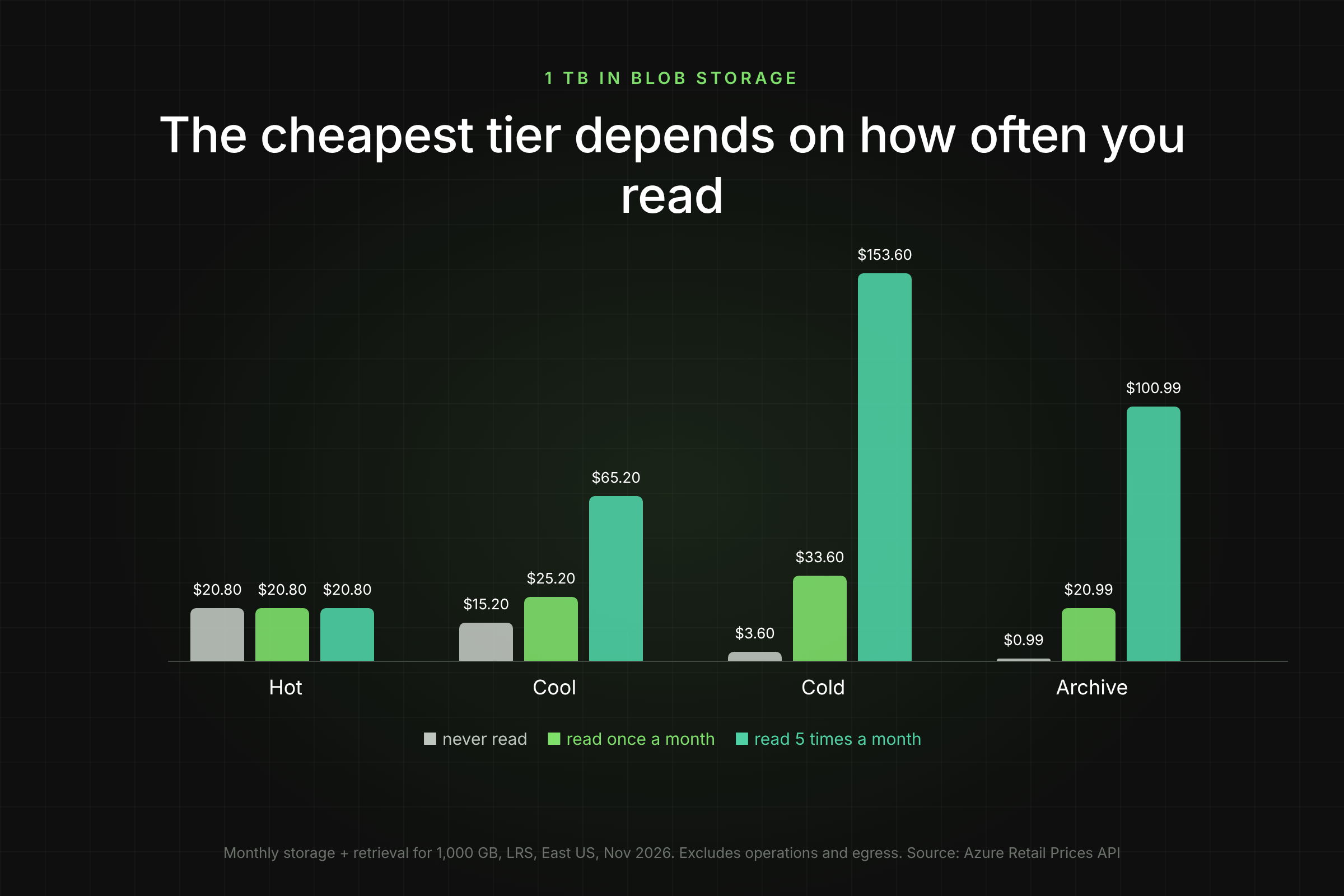
The decision rule is simple: pick the tier by how often data is read, not by how old it is. A 1 TB dataset read once a month costs $20.80 in Hot. In Cold it costs $3.60 to store plus $30 to retrieve, so $33.60. The "cheaper" tier costs 62 percent more for that access pattern.
Archive is offline. Blobs must be rehydrated before they can be read, which Microsoft says can take up to 15 hours at standard priority. Use it for compliance copies and backups you hope never to read.
What Else Drives the Bill?
After the tier, three factors move Azure storage cost the most: redundancy, transactions and egress. Each can add more than the capacity line itself.
Redundancy
Redundancy multiplies the capacity price. In East US, Hot Blob costs $0.0208 per GB-month on LRS, $0.026 on ZRS (25 percent more) and $0.0458 on GRS (120 percent more). Write operations cost more on redundant tiers too: $0.05 per 10,000 on LRS, $0.0625 on ZRS and $0.10 on GRS.
Match redundancy to the recovery objective of the data, not to a company-wide default. Logs you can regenerate rarely need GRS; customer records often do. Our Azure Blob redundancy guide covers the trade-offs in detail.
Transactions
Operations bill per 10,000 requests. Small-object workloads feel this most: an application writing 10 million 4 KB objects a day pays $1,500 a month in Hot write operations (10,000,000 x 30 / 10,000 x $0.05), for only about 1.2 TB of data.
Egress
Data leaving Azure to the internet is free for the first 100 GB a month, then $0.087 per GB for roughly the next 10 TB on the default Microsoft network, falling to $0.083, $0.07 and $0.05 at higher volumes. Routing over the public internet (Routing Preference: Internet) is cheaper at $0.08 per GB for the first band. Moving data between availability zones costs $0.01 per GB and between regions $0.02 per GB within North America or within Europe; other routes cost more (Azure Retail Prices API, Bandwidth).
How Much do Azure Files and Managed Disks Cost?
Azure Files bills either by data stored (pay-as-you-go) or by what you provision; managed disks always bill by provisioned size and tier. That difference decides whether unused space costs you anything.
Azure Files
Microsoft recommends provisioned v2 for new deployments: you set storage, IOPS and throughput separately, with SSD minimums of 32 GiB, 3,000 IOPS and 100 MiB/s (Microsoft Learn, Azure Files billing). Price IOPS and throughput in the Azure pricing calculator, since the meters bill hourly.
Managed disks
Premium SSD, Standard SSD and Standard HDD bill at the size tier the disk falls into, so a 600 GiB disk pays for 1 TiB. Premium SSD v2 bills per GiB ($0.0803), per IOPS above 3,000 and per MB/s above 125. Our guide to how Azure managed disk billing works covers the tiers. [Swap for the live URL once published.]
What do Real Workloads Cost?
Three worked examples, with every line traceable to the price tables above (East US, Nov 2026).
Blob: 50 TB Hot LRS with traffic
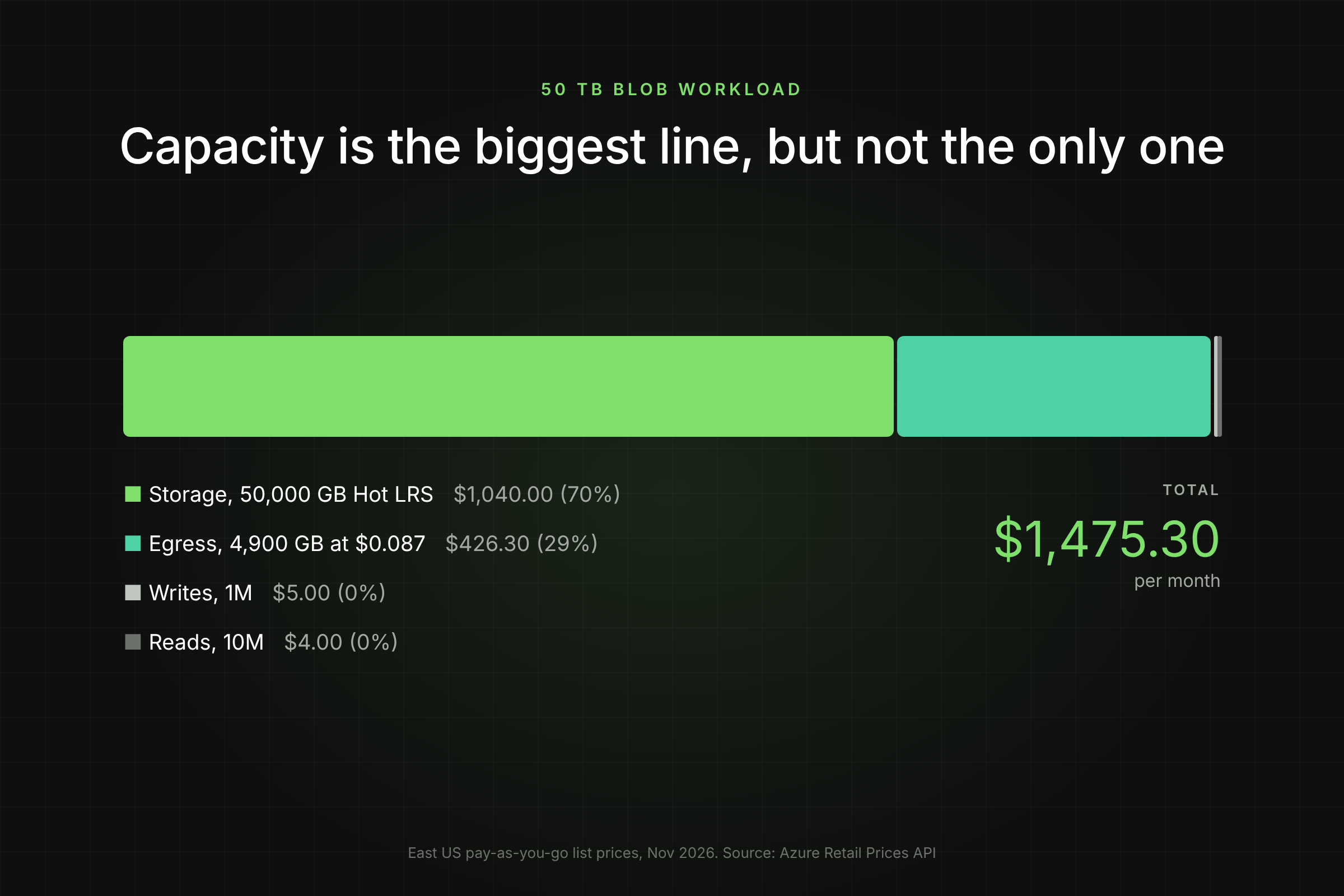
Assumptions: 50 TB (50,000 GB) stored in Hot LRS, 10 million reads and 1 million writes a month, and 5,000 GB (10 percent of the data) downloaded to the internet each month.
Egress is 29 percent of the total. If half the data is rarely read, moving 25 TB to Cool saves 25,000 x ($0.0208 - $0.0152) = $140.00 a month, before retrieval fees on what you do read.
Azure Files: 5 TiB Hot share
Assumptions: 5 TiB (5,120 GB) stored in a Hot LRS share and 1 million writes a month. Storage is 5,120 GB x $0.0287 = $146.94, plus 1 million writes at $0.065 per 10,000 = $6.50. Total: $153.44 a month. The same 5 TiB on SSD provisioned v1 costs 5,120 x $0.16 = $819.20, which is justified only if the share needs SSD latency and IOPS.
Managed Disks: 20 VMs with 1 TiB Premium Data Disks
Assumptions: 20 VMs, each with a 1 TiB Premium SSD P30 data disk, and measured IOPS that fit inside the Premium SSD v2 baseline (3,000 IOPS, 125 MB/s). Today they cost 20 x $135.17 = $2,703.40 a month. The same disks on v2 cost 20 x $82.23 = $1,644.60, saving $1,058.80 a month. The change needs a VM deallocation and has constraints (data disks only, no host caching), covered in our break-even guide for changing an Azure disk type.
Which Hidden Costs do Teams Miss?
The lines that surprise finance teams are the ones nobody provisions on purpose. Four account for most of the surprises.
- Idle and unattached disks. A disk keeps billing at its tier after its VM is deleted. One forgotten 1 TiB P30 is $135.17 a month, $1,622.04 a year.
- Early deletion. Moving a blob out of Cool after 21 days bills the remaining 9 days. Lifecycle rules that tier data too early, then delete it, pay twice.
- Archive reads. At $5.00 per 10,000 reads plus $0.02 per GB, a restore of 100 million small archived files costs $50,000 in read operations alone. Bundle small files before archiving.
- Snapshots and soft delete. Incremental disk snapshots bill on used size at $0.05 per GB-month, and soft-deleted Blob and Files data keeps billing until the retention ends. Old snapshots from one-off migrations are a common leftover.
Optional Blob features carry their own meters as well. Index tags, for example, cost $0.03 per 10,000 tags a month in Hot LRS.
How do You Find your Biggest Storage Cost Lines?
Start in Cost Management, then confirm with inventory queries. Cost Management shows which meters cost the most; Resource Graph shows which resources sit behind them.
- In Cost Management, open Cost analysis, group by Meter and filter Service name to Storage. Sort by cost for the last 30 days.
- Group by Resource to find the storage accounts and disks behind the top meters.
- List unattached managed disks across subscriptions. Run it in Azure Cloud Shell, or in any shell where Azure CLI is signed in with az login and the Resource Graph extension is installed (az extension add --name resource-graph). It covers every subscription your account can read; add --subscriptions <subscription-id> to limit it to one:
az graph query -q "
Resources
| where type =~ 'microsoft.compute/disks'
| where properties.diskState =~ 'Unattached'
| project subscriptionId, resourceGroup, name, sku=tostring(sku.name),
sizeGb=toint(properties.diskSizeGB), timeCreated=properties.timeCreated
| order by sizeGb desc" --first 1000 -o table
- For Blob, enable blob inventory or check Storage insights to see capacity by tier and container before changing lifecycle rules.
To skip the queries, switch on Lucidity Free Insights for a read-only report of idle disks, oversized disks and Blob tiering opportunities across your Azure subscriptions.
How do you Reduce Azure storage Cost Safely?
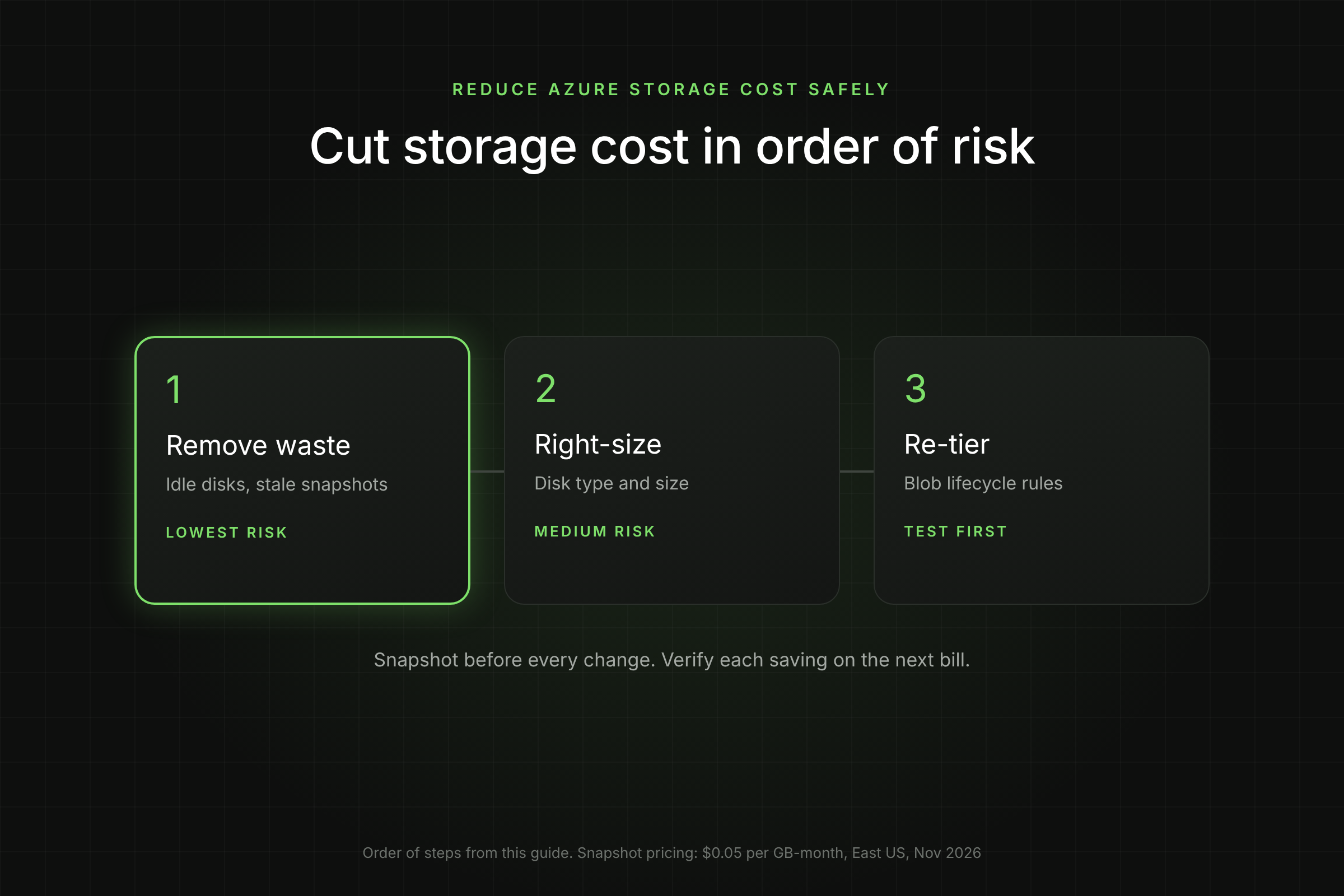
Every storage saving is a change to production data, so each one needs a rollback path. Use this order: remove waste first, then right-size, then re-tier.
1. Remove idle disks and stale snapshots
Snapshot an unattached disk, confirm the owner, then delete the disk. Keep the snapshot for 30 days; at $0.05 per GB-month on used size it costs a fraction of the disk.
diskId=$(az disk show -g $rg -n $diskName --query id -o tsv)
az snapshot create -g $rg -n ${diskName}-final --source $diskId --incremental true
az disk delete -g $rg -n $diskName --yes
2. Right-size Managed disks
Move disks with low IOPS to a cheaper type, and disks with low used space to a smaller size. Azure cannot shrink a disk in place; Lucidity AutoScaler expands and shrinks managed disks live, with no downtime, so capacity follows real usage.
3. Re-tier Blob Data with Lifecycle Rules
Write rules on last access time, not creation time, so data that is still read stays hot. Test the rule on one container first, and check that minimum retention periods do not trigger early-deletion charges on data the rule moves twice.
4. Verify on the Bill
After each change, compare the next month's meter in Cost Management against your forecast. A saving that does not show on the invoice did not happen.
Frequently Asked Questions
What is the cheapest Azure storage?
Archive Blob at $0.00099 per GB-month LRS in East US, about $1 per TB. It is offline storage with a 180-day minimum and rehydration of up to 15 hours, so it suits backups and compliance data only.
How much does 1 TB of Azure Blob storage cost?
About $20.80 a month in Hot LRS, $15.20 in Cool, $3.60 in Cold and $0.99 in Archive, in East US. Add operations, retrieval and egress for the way you use the data.
Is Azure egress charged for data within a region?
Traffic within the same availability zone is free. Moving data between availability zones costs $0.01 per GB, between regions $0.02 per GB within North America or within Europe (more on other routes), and to the internet $0.087 per GB after the first free 100 GB a month.
Do managed disks charge for unused space?
Yes. Premium SSD, Standard SSD and Standard HDD bill for the full size tier, whatever the data inside. Only Premium SSD v2 and Ultra Disk bill per provisioned GiB, and none bill on used space.
Are reservations worth it for Azure storage?
For steady Blob capacity above 100 TiB, usually. Blob reserved capacity is sold in 100 TiB and 1 PiB blocks for one or three years. Check the discount for your region and tier in the pricing calculator before you commit.
Table of Contents
Sign Up