


Save up to 70%
on your block storage bill
Reclaim 100s
of DevOps hours
Zero downtime
or infrastructure changes
Block storage is full of waste. Lucidity removes it.
Block storage is a significant part of enterprise environments, but with 30% average disk utilization and 2/3rds of disks mis-tiered, waste is costly and hard to address.
- See
Uncover hidden metrics
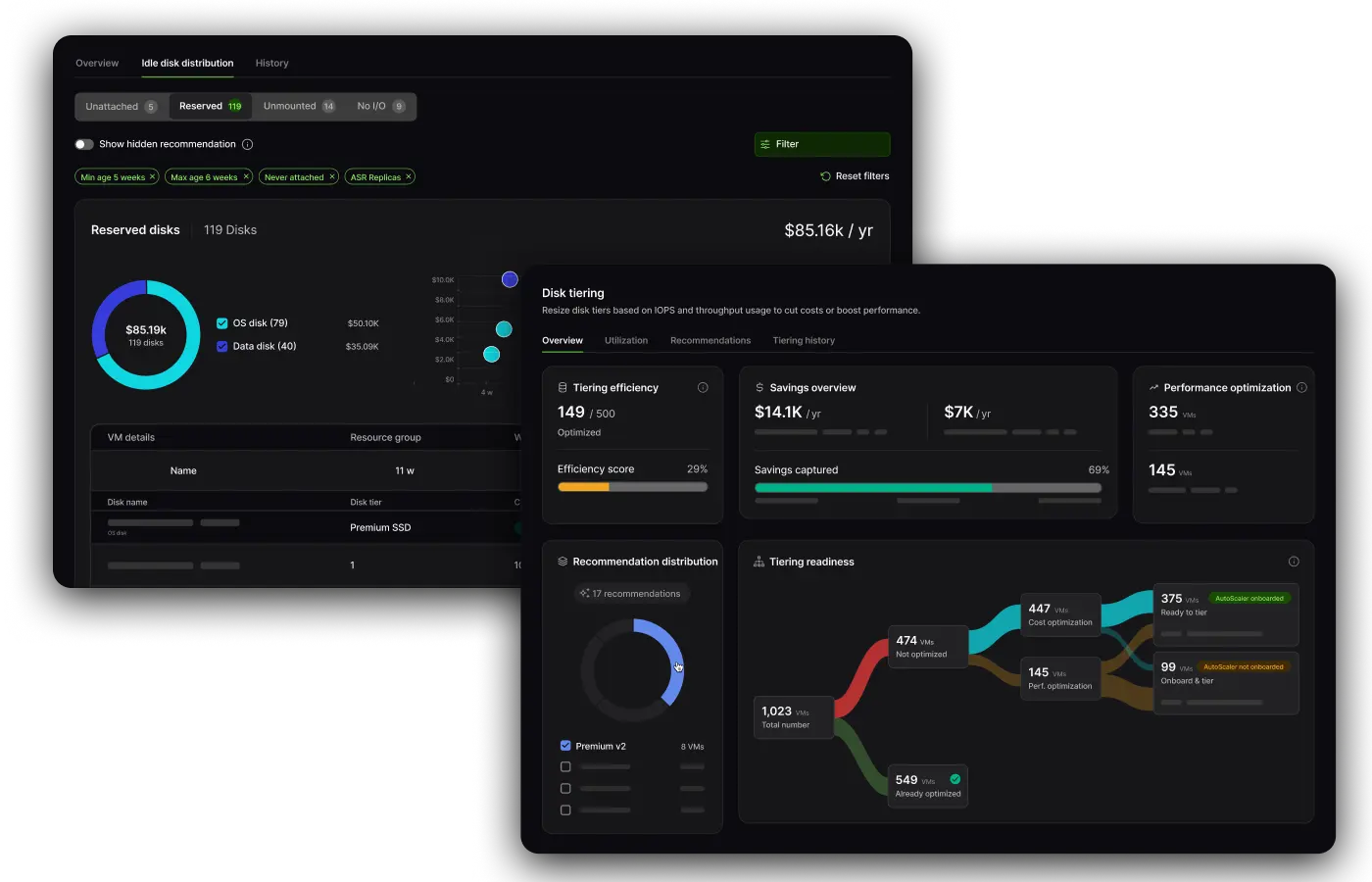
Understand the state of your block storage environment across capacity, tiering, and idle disks for the first time.
- Act
Eliminate waste autonomously
Right-size disks in real-time, completely autonomously. Right-tier and remove idle disks in one click with recommendations based on your actual usage.
- Govern
Strengthen best practices
Apply scaling policies to balance cost and performance across the organization and ensure that the right practices are being followed when new disks are spun up.
Eliminate block storage waste autonomously with no downtime
Trusted by industry leaders

“We used to spend countless hours provisioning our cloud block storage. With Lucidity, we were able to not only free up that time by automating our storage management, but were able to save significant cost on our annual block storage spend.”


“The daily operational lift of managing disk space has moved off of our support to Lucidity.”


“Lucidity helped us to eliminate the risk of possible downtimes, and reduce our cloud storage spend by 52%”


“Lucidity is a game-changer in cloud storage management, helping enterprises optimize storage utilization, enhance performance, and significantly reduce costs across all three major cloud providers.”


“We used to spend countless hours provisioning our cloud block storage. With Lucidity, we were able to not only free up that time by automating our storage management, but were able to save significant cost on our annual block storage spend.”
“The daily operational lift of managing disk space has moved off of our support to Lucidity.”
“Lucidity helped us to eliminate the risk of possible downtimes, and reduce our cloud storage spend by 52%”
“Lucidity is a game-changer in cloud storage management, helping enterprises optimize storage utilization, enhance performance, and significantly reduce costs across all three major cloud providers.”
Frequently asked questions
Block storage optimization is the practice of matching provisioned disk capacity and performance to what workloads actually consume. It covers three levers: right-sizing volumes to real utilization, moving disks to the tier their IOPS and throughput justify, and reclaiming idle disks. On AWS, Azure, and Google Cloud, that means EBS volumes, Managed Disks, and Persistent Disks.
Running out of disk space causes downtime, so teams provision for peak plus a safety margin and rarely revisit it. Cloud providers bill on provisioned capacity rather than consumed capacity, so that margin never shows up as a line item. Native tooling reports what you allocated, not what the filesystem is actually holding, which leaves the gap unmeasured. Average enterprise disk utilization sits near 30%.
Right-sizing changes how much capacity a disk has. Tiering changes the class of performance it runs on. Idle disk cleanup reclaims volumes nothing is attached to or reading from. They address different waste and they stack: a single disk can be over-provisioned by 60%, sitting on a premium tier its IOPS never justify, on a host that was decommissioned last quarter. The Lucidity Cloud OS covers all three through Disk AutoScaler, Disk Tiering, and Disk Cleanup, in one control plane.
Customers save up to 70% on their block storage bill. Lucidity has taken more than 2.3 million autonomous actions across 17 PB of production storage, moving average disk utilization from roughly 30% to 76%. Block storage is one part of a wider platform outcome: a 7 to 15% reduction in the total cloud bill across block and object storage.
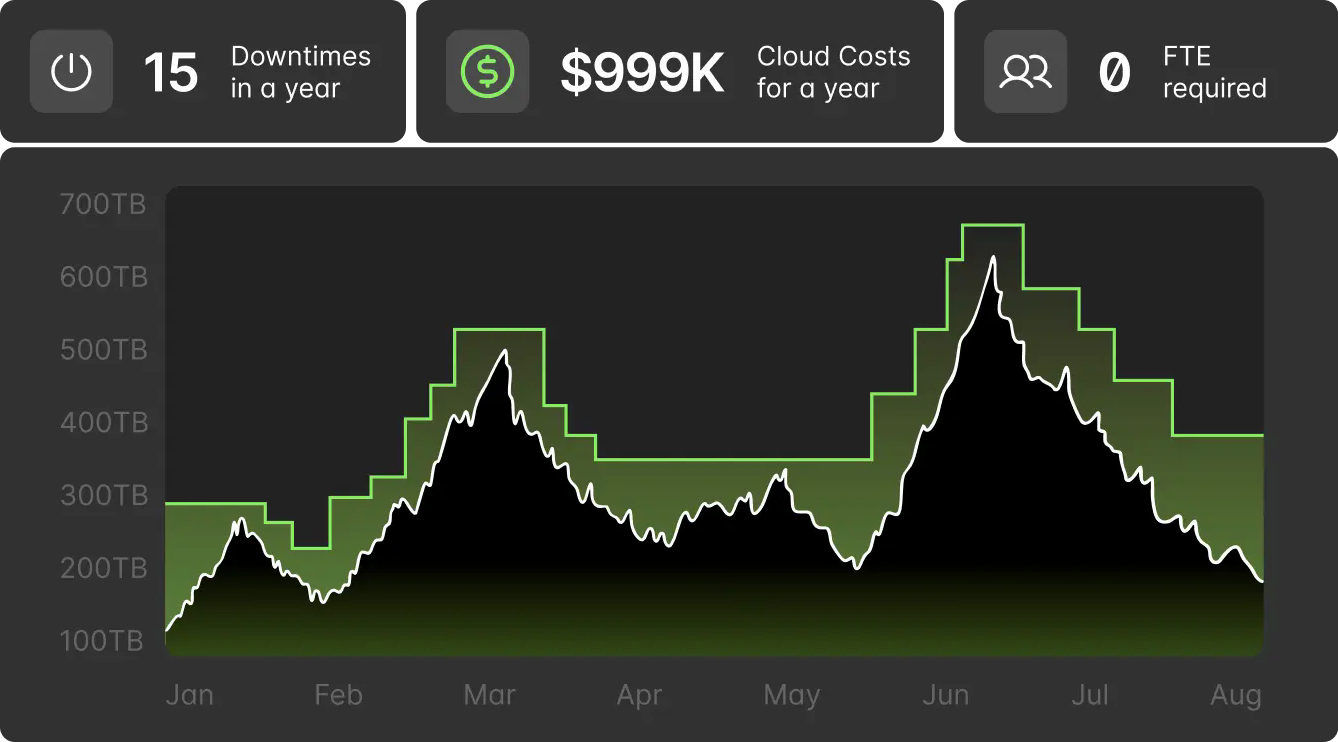
Done by hand, it does. Shrinking a volume on AWS or Azure means snapshotting it, creating a new disk, copying the data across, and remounting, which needs a maintenance window and engineering time. Disk AutoScaler works on the live volume instead. Expansion completes in under 60 seconds, shrink operations complete in two to four minutes, and neither requires a code change, a storage migration, or an infrastructure change.
Yes. Lucidity's zero-downtime resize is patented and operates on the live volume, so the filesystem stays mounted and the application keeps serving throughout. Actions are precise and targeted at specific over-provisioned volumes, not broad sweeping changes, and every one is risk-scored before it runs, then logged, auditable, and reversible. You set the boundaries through scaling policies: utilization thresholds, buffers, and performance floors that Disk AutoScaler operates inside.
Lucidity never reads, copies, or moves your application data. Visibility is agentless and read-only, drawing on cloud-native metrics and APIs, so you can run a full Lucidity Assessment across your estate without installing anything. Autonomous block actions use a lightweight agent with scoped permissions that reads storage metadata at the OS level and executes scaling commands, running at roughly 2% CPU and 200MB RAM on a typical VM. Lucidity is SOC 2 Type II certified, and Private Link is available.
Native tools produce recommendations from provisioned capacity and leave the change to you as a manual, maintenance-window task. Lucidity measures utilization at the filesystem level, then acts on it: Disk AutoScaler right-sizes continuously and autonomously, while Disk Tiering and Disk Cleanup execute in one click with the evidence behind each recommendation shown. Coverage is broader too, with roughly 65% of idle disks invisible to native cloud tools.
AWS (EBS), Microsoft Azure (Managed Disks), and Google Cloud (Persistent Disks), including AWS EKS through the CSI driver. Disk AutoScaler supports Linux distributions including Amazon Linux, Ubuntu, CentOS, RHEL, and SUSE, plus Windows Server 2016, 2019, and 2022. Databases, application servers, and stateful Kubernetes workloads are all in scope. The full compatibility matrix is in the Lucidity documentation.
The free Lucidity Assessment takes about 15 minutes and returns your recoverable number before you install anything. Once Disk AutoScaler is onboarded, right-sizing starts immediately and savings appear in the next billing cycle. Most customers reach ROI within 60 to 90 days.
Pricing is consumption-based and comes with a money-back guarantee. Lucidity is also available through the AWS Marketplace and the Azure Marketplace, so the spend can draw down an existing cloud commitment. Talk to the team for a quote against your estate.