Ask any cloud team how much they could save, and you will get a confident number. Ask how much of that number actually reached the bill, and the room gets quiet.
That silence is the most expensive gap in cloud cost today. The industry has become very good at showing potential savings. It has not become nearly as good at delivering them.
Today we are introducing the Lucidity AI Action Engine, built around one promise: cloud savings, delivered. We ensure that the savings reach the bill, and not stay restricted to your cost dashboards.
To explain why we built it, we have to start with where Lucidity began.
Where we started?
Lucidity began with storage, one of the hardest problems in cloud cost. We deliberately took on the storage that sits directly underneath live production workloads, which is hard to see into, hard to change safely, and unforgiving when you get it wrong.
Its waste rarely shows up in billing data. It hides inside how infrastructure is managed: disks provisioned for a peak that never comes, data sitting on tiers it no longer needs, object storage configured once and never revisited. Touch it carelessly and something breaks.
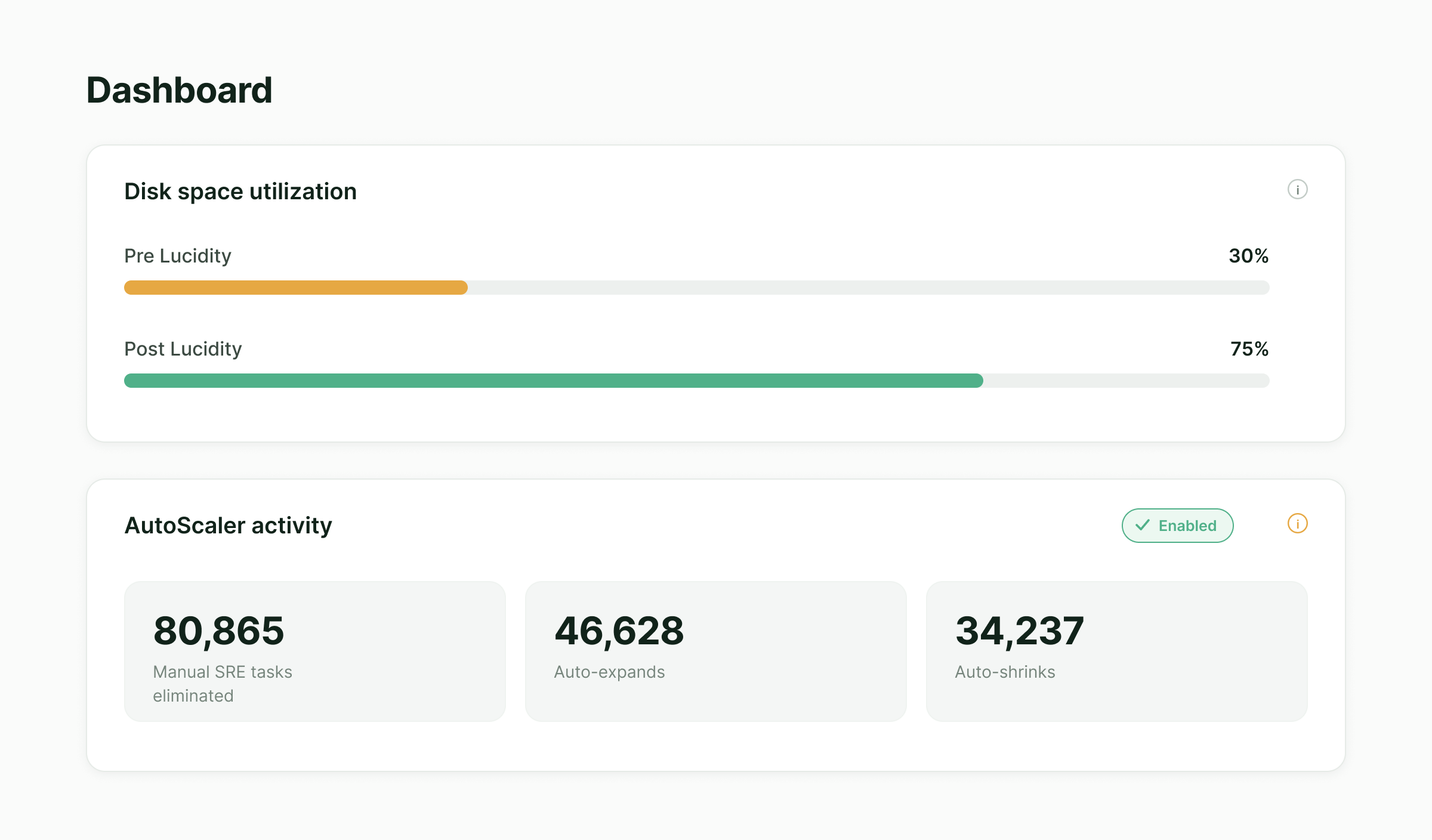
The missing piece was the action layer. Recommendations to tier or right-size storage stayed on the dashboard because acting on them risked downtime. So we solved the harder problems first: right-sizing block storage without downtime, so it adjusts itself to what workloads need, and tiering disks without downtime. We built the IP behind both, and added object storage optimization that goes well beyond generic lifecycle rules.
We have never shied away from the difficult part, because we committed to solving the customer's problem end to end.
What storage taught us
Today Lucidity works with 100+ enterprises. We have identified more than $500M in savings and taken over 1.5M actions on production infrastructure. Doing that at scale taught us three things.
First, the best savings are not on the surface. They come from understanding infrastructure deeply enough to see what generic FinOps tools miss.
Second, a recommendation is only as good as its context. The same change can be smart for one workload and dangerous for another. Without knowing which is which, engineers cannot trust it.
Third, finding is only half the job. Savings exist only when the change is made, monitored, and proven safe.
None of these lessons are unique to storage. They describe the whole cloud bill.
What our customers showed us
One customer's experience captures the problem. Their FinOps tools had already recommended disk tiering, but the team never acted on it. Doing it safely meant gathering context, checking the tier was right, simulating the change, making it and then monitoring it. For about $100 saved per disk, that effort was never worth it. Lucidity handled all of it end to end.
Then customers started asking for more. Could we do the same for compute right-sizing? For PaaS offerings? That told us the gap was much bigger than storage. Wherever a recommendation has to become a safe change in production, teams hit the same wall. Engineering, platform and FinOps leaders describe it the same way. Tools miss the deeper opportunities. Recommendations lack the context engineers need to trust them: a right-sizing suggestion does not know that a workload is in production, that it spikes at month-end, or that someone already fixed it last week. And valid changes sit in the backlog, because each needs an owner, an approval, a change window and a rollback plan, and the saving is either too small for the effort or the risk too high. The result is savings that exist on a dashboard and nowhere else.
Introducing the Lucidity AI Action Engine
The AI Action Engine takes everything we learned in storage and applies it across cloud cost. Its AI agents work in three steps, each one answering a reason savings stall today.
Find deeper. AI agents inspect how your disks, storage accounts and VMs are set up and used, and find waste that generic FinOps tools miss. Across our customers, that adds up to 2x the opportunities those tools find.
Decide confidently. AI agents build the context around each opportunity, such as whether a workload is in production, how it behaves over time, and who owns it. Then they validate which changes are safe to act on, so you only see the ones you can trust.
Act safely. AI agents make the change once you approve, or on their own for the actions you choose. Every change is monitored, verified, logged and reversible.

Through all of it, a human stays in the loop. You set the guardrails: which actions are allowed, which need approval, and when changes can run. You approve. Agents act. Every change on record.
Most tools stop at the recommendation and hand the rest to engineering. The AI Action Engine carries it all the way to your bill.
What changes for each team
For engineering leaders, cloud cost stops being another project competing with the roadmap. Engineers no longer investigate hundreds of recommendations to find the few worth doing.
For platform and infrastructure teams, every change arrives with evidence and runs inside the controls they already own. For FinOps, the savings pipeline finally turns into savings delivered, which builds credibility with engineering. And for finance, the cloud savings will finally make it to the P&L.
The difference in numbers
Most FinOps approaches deliver around 10% in savings. Unlike these, because the AI Action Engine goes deeper and carries opportunities through to execution, it can help reduce cloud costs by up to 40%.

The number we hold ourselves to
Up to 40% is a meaningful figure. But a savings estimate, however large, is still only a promise. The number that matters is how much of it actually reaches your bill.That is why we measure ourselves on what gets delivered, not what gets identified. It is a harder standard. It only moves when the opportunities are deep enough to be worth doing, the context is strong enough for engineers to trust them, and the change makes it to production.

Delivering the savings is our single focus. The agents do the work, and people stay accountable for the outcome. We commit to a savings number for each customer and put everything behind it: a product built to carry changes through to production, plus a technical solutions architect, a cloud consultant, a customer success manager and a program manager working to make sure the savings are achieved.
We think every cloud team should ask its tools the same question: of the savings you find, how much do you deliver?
See what you could deliver
The easiest way to see the difference is in your own environment. Switch on Insights and see what the AI Action Engine finds in it.
We started Lucidity by doing the hard part of cloud. With the AI Action Engine, we are bringing that same discipline to your entire cloud bill.
Table of Contents
Sign Up