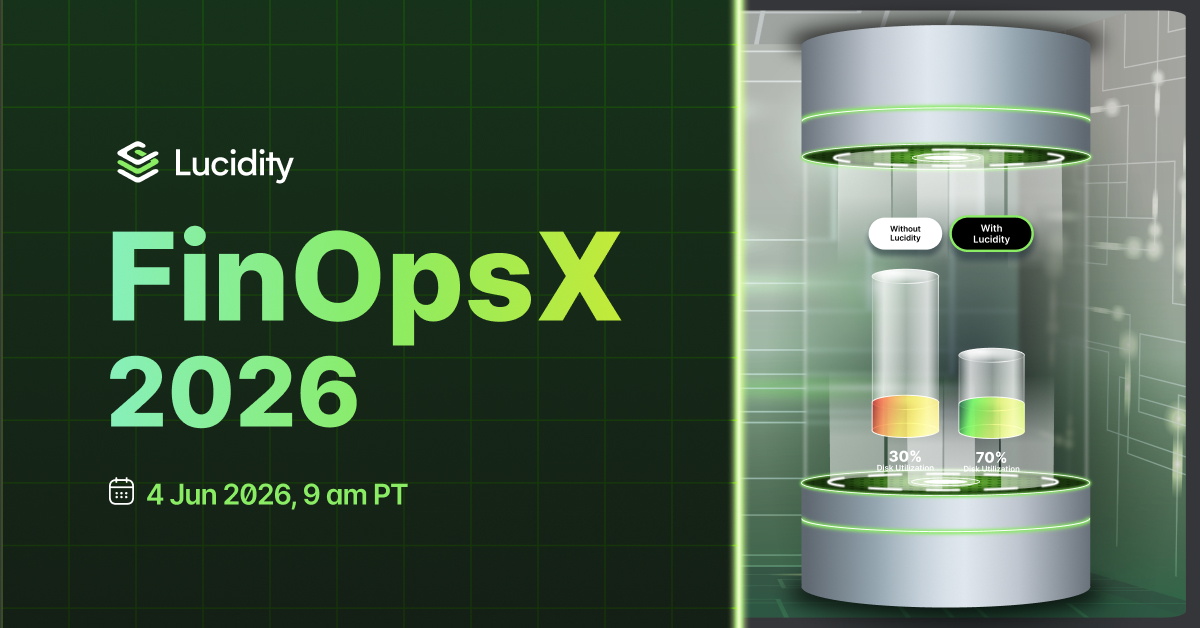
A month has passed since the FinOps community gathered in San Diego for FinOps X 2026, and the conversations are still worth revisiting. We were on the show floor all three days, and we came back with a full notebook. Now that the dust has settled, here are the takeaways that stuck with us, and what they mean for anyone trying to keep cloud storage costs under control in an AI-driven world.
AI is driving up the cost of all cloud components
The AI cost conversation tends to start and end with GPUs, but that is only the part of the bill everyone can see. AI pushes up compute, networking and egress, data platform spend, and storage all at once. The numbers back this up: 94% of organizations say their cloud storage costs are rising, and 54% say storage spend is now growing faster than their overall cloud bill. On our own side, we have watched storage rise to a top two cloud bill line item, driven in part by AI workloads. Sonali Niswander of MetLife put it well in her fireside chat: “AI is cloud all over again, only 10x faster.” The same dynamics that made cloud costs hard to govern a decade ago are back, compressed into a much shorter timeline, and they are touching every component of the bill at once.
With the rise of AI, cloud storage optimization is more important than ever
Token economics dominated the agenda, and for good reason. But every token has to be fed. AI workloads run on data, and data lives on storage. Training sets, checkpoints, vector databases, feature stores, logs, and the copies of copies that pipelines generate all land on block and object storage, and they grow quickly. Storage already sat near the top of the bill before any of this: roughly the second-largest line item and about a third of total cloud spend. As AI scales, that footprint scales with it. The practitioners we talked to are feeling it firsthand. Storage that was a manageable background cost a year ago is now a line item that deserves the same scrutiny teams have long given compute.
Storage is the overlooked scope in the AI rush
One of this year's featured tracks was FinOps Scopes, the idea that FinOps now extends across public cloud, data center, SaaS, licensing, and data platforms. That expansion matters, because while the industry has been chasing tokens at the top of the stack, the infrastructure underneath keeps compounding. Compute has been optimized to a fine point over the past several years. Storage, for most organizations, has gone untouched. The result is predictable: average disk utilization sits around 30%, ~50% of cloud storage spend is recoverable, and roughly 65% of idle disks never show up in native tooling. Object storage is its own black box, rolling millions of blobs into a single line on the bill with no analytical layer underneath. Gartner made the same point last year, noting that rising storage costs stem from over-provisioning, poor lifecycle management, and outdated manual controls. The takeaway for us is simple: storage is the scope with the most waste and the least attention, and AI is only widening that gap.
Agentic FinOps: from alerts to autonomous action
If token economics was the headline of day one, agentic FinOps was the throughline of day two. Ishita Vyas walked the community through a Crawl, Walk, Run model for agentic maturity, and nearly every vendor on the keynote stage, from AWS to Google Cloud to ProsperOps, framed their roadmap around the same shift: moving from reactive, post-billing alerts toward proactive, autonomous control. Mike Fuller framed the human side of it clearly. AI will not take FinOps jobs, but practitioners who know AI will pull ahead, and as AI scales decisions, FinOps scales in importance. This is the wave storage optimization should be riding. Surfacing a recommendation is no longer enough. The value shows up when the system right-sizes over-provisioned volumes autonomously, re-tiers data as access patterns change, and does it all without downtime. Alerts tell you where the waste is. Agentic action removes it.
Optimize for value, not just cost
For all the talk about tokens and agents, the most grounding sessions came back to a familiar FinOps idea: optimizing for value, not just cutting spend. Token economics is really a question about the value of intelligence, what you get back for every dollar you convert into tokens. The same lens applies to storage. Right-sizing keeps performance and headroom intact while making sure every dollar of storage spend is doing real work, so utilization moves from 30% toward 75% instead of sitting idle. For most teams, tightening up storage frees 7 to 15% of the total cloud bill. In an AI-driven budget, that is money you can redirect into the workloads that actually differentiate the business.
One month on
The throughline is hard to miss: AI is raising the stakes on every part of the cloud bill, and storage is one of the largest and least examined pieces of it. If FinOps X left you thinking about where AI is pushing your spend next, storage is a good place to look. At Lucidity, we’re tackling cloud storage optimization holistically, so we’re happy to chat about what we’re seeing, or you can run a free trial to see what your opportunities are for optimizing cloud storage.
Table of Contents
Sign Up
.jpg)